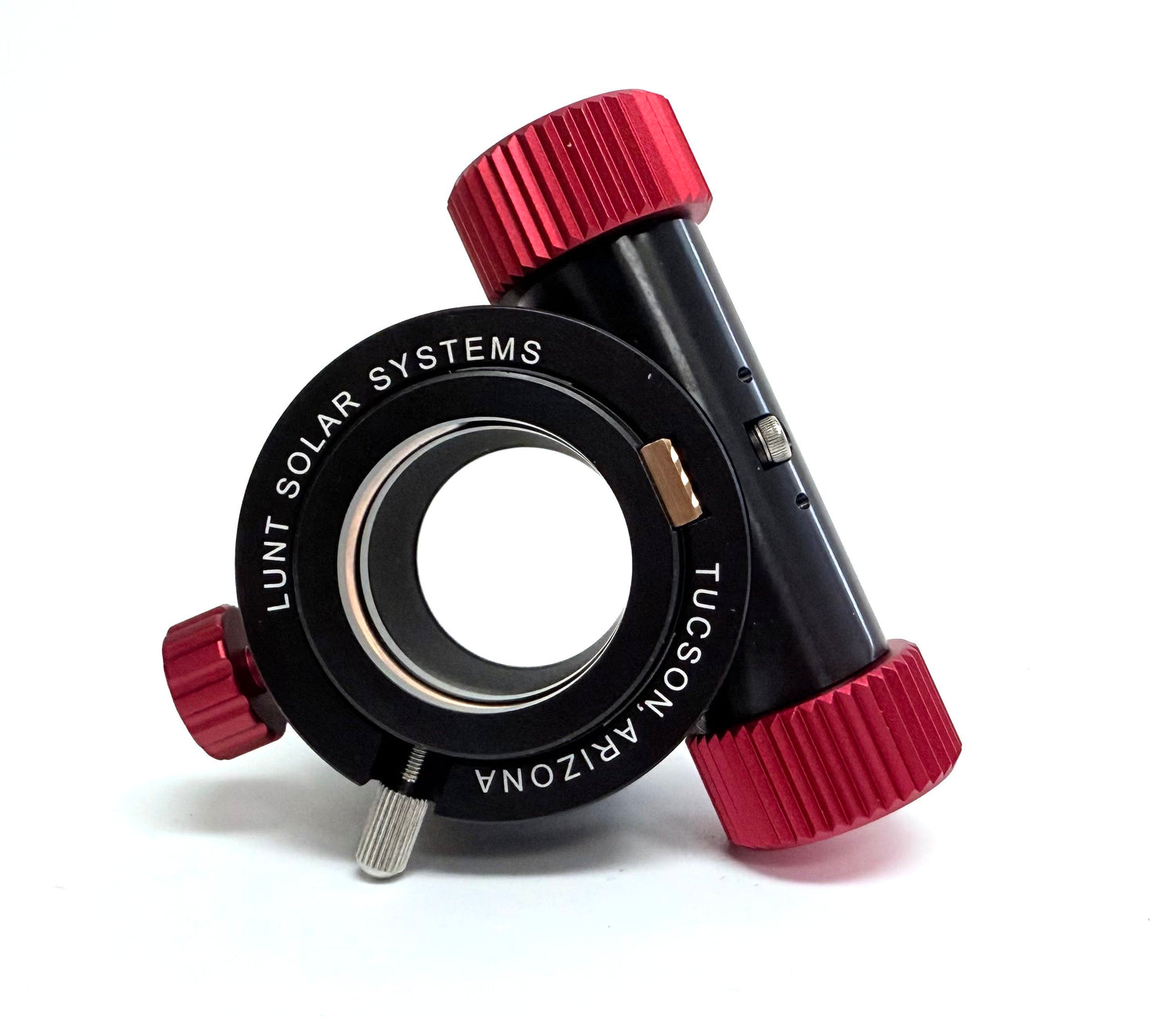


Why 20 Years of Pressure Tuning Matters — The Architecture That Changed Solar Astronomy
Share
This is the sixth and final post in a series that began with the physics of etalon tuning and worked through the practical consequences of design choices — bandpass uniformity, altitude sensitivity, optical contact fatigue, kinematic mounting, and Doppler capability. If you have read the previous five posts, you understand the technical case for pressure tuning in considerable detail.
This post is different. It is about where these ideas came from, why they matter beyond the technical arguments, and what the history of this industry tells us about the choices that determine whether a company and its products endure.
I am going to write it in first person, because the history is personal.
My Father's Company
My father, David Lunt, began developing ultra-narrowband optical filters and instruments for NASA and the professional astronomy market in 1965. He spent decades in the field before founding Coronado Instrument Group in 1997 — at a point in his career when most people would be thinking about slowing down. He was not most people.
Coronado's founding premise was simple and right: the chromosphere of the Sun is the most dynamic, accessible, and visually spectacular target in astronomy, and virtually no amateur astronomer could observe it because the equipment required was the exclusive domain of professional observatories. David Lunt set out to change that. Within a few years, Coronado had done exactly that — the Personal Solar Telescope brought hydrogen-alpha solar observing to a mass market for the first time, and the premium MaxScope line gave serious amateurs access to performance that had previously required institutional budgets.
I was the lead engineer at Coronado throughout this period. I designed most of the product line. I worked on every aspect of etalon manufacturing, mechanical design, and optical performance. And I worked directly on the problems that this blog series has been about — internal tilt tuning, mechanical compression, and why both of them fell short of what I believed a properly designed solar etalon system should deliver.
The Problems I Worked With
The compression-based designs we used at Coronado — and the internal tilt systems we tried and abandoned — were not bad engineering. They were engineering solutions to real problems, constrained by the manufacturing capabilities and design philosophies of the time. But they had failure modes I observed directly and understood deeply.
The non-uniform gap from centre-point loading was visible in the bandpass data. The altitude sensitivity of the open cavity meant that instruments calibrated in our Tucson facility performed differently at other elevations. The internal tilt systems — we tried them with collimating lens sets, and I was the engineer who watched the banding appear at the edges of the aperture as we pushed the tilt range. We abandoned internal tilt not reluctantly but definitively, because the physics were clear: no practical collimating lens system can perfectly collimate off-axis rays, and the usable tilt range before banding becomes objectionable is too narrow to provide meaningful Doppler capability.
What I wanted — and could not build within the Coronado design framework — was a system that applied no mechanical force to the optical element during tuning. A system that was immune to altitude and barometric change. A system with no cyclic loading on any bonded interface. A system whose tuning range covered the full hydrogen-alpha line instantly, precisely, and repeatably from any location.
The physics of how to achieve this was not a mystery. Changing the refractive index of air in a sealed cavity — pressure tuning — satisfied all of those requirements simultaneously. The challenge was engineering a practical sealed cavity system with the manufacturing precision required to make it work reliably at production scale.
The Sale, and What Came After
In 2004, Coronado was sold to Meade Instruments. My father had become ill, and circumstances led to the sale — a decision I had no control over and one that, with the benefit of hindsight, represented a significant missed opportunity. The sale price was approximately $1.7 million. The eclipse seasons that followed — 2017, 2024, and the 2026 European eclipse now approaching — generated solar telescope and eclipse glasses revenue that dwarfed that figure many times over.
My father passed away not long after the sale. He had told me that one day I would own Coronado. That did not happen.
What happened instead was that I founded Lunt Solar Systems, and I built the instrument I had always wanted to build.
The Development of Pressure Tuning
The sealed pressure-tuned cavity was my own design, developed at Lunt Solar Systems from first principles informed by years of direct experience with what didn't work. The etalon is suspended in a sealed chamber on small silicone isolation pads — compliant enough to absorb vibration and thermal disturbance, rigid enough to survive shipping. The tuning knob changes the air pressure inside the sealed cavity, changing the refractive index of the air throughout the chamber, shifting the centre wavelength of the etalon without touching it.
When I attempted to patent the approach, I was advised that while no patent exisited, prior art did exist in space-based optical instrumentation — sealed cavity refractive index control had been used in precision space systems before it was applied to amateur solar telescopes. No patent was granted.
This is worth reflecting on. The fact that space optical engineers had arrived at the same architectural solution independently — through completely different application requirements and development paths — is not a weakness of the approach. It is a confirmation of it. When engineers working on the most demanding optical systems in existence, with unlimited budgets and the finest optical engineering resources on the planet, converge on the same fundamental architecture as a small telescope company in Tucson, Arizona, that convergence is telling you something about the physics. The architecture is correct not because it was patented or proprietary but because the engineering logic demands it.
The design addressed every failure mode I had observed at Coronado. No centre foot. No cyclic mechanical loading on any bonded interface. No open cavity sensitive to altitude or barometric change. No mechanical coupling between the tuning mechanism and the optical surfaces. And a tuning range that covered the full hydrogen-alpha line — from the red wing through line centre to the blue wing — instantly, with a precision and repeatability that the pressure-to-wavelength relationship of sealed air provides as a physical constant.
What Happened to Coronado
After the sale to Meade, the story of Coronado is one of gradual decline. Meade moved Coronado's manufacturing out of Tucson in 2006, dispersing the team that had built the product line. The institutional knowledge that had accumulated over a decade of precision etalon manufacturing left with the people who held it. The product line continued under the Coronado brand name, but the engineering capability that had created it was no longer intact.
Meade itself struggled through financial difficulties, bankruptcy proceedings, and successive ownership changes. As of December 2024, Sky & Telescope announced that the assets of Meade, Coronado, and Orion Telescopes and Binoculars would be listed for auction and that these companies were ceasing operations. Wikipedia Coronado — the brand my father built, the company where I spent the formative years of my engineering career — no longer exists as an operating entity.
This is not a story I tell with any satisfaction. My father's life work deserved a better outcome. But it is a relevant fact for anyone evaluating the solar telescope market today: the Coronado compression-based design lineage has ended. The company is gone. The brand survives only as intellectual property in an auction catalogue.
Lunt Solar Systems continues to manufacture, to innovate, and to grow — preparing for the 2026 European eclipse with the most technically capable product line we have ever offered.
The Sky-Watcher Heliostar in Historical Context
The Sky-Watcher Heliostar's appearance in the market is, in the context of this history, an interesting development. An independent reviewer on Cloudy Nights noted that the Heliostar was made possible by the expiration of the original Coronado patents — the compression and RichView tuning intellectual property that had been Coronado's core IP, developed during the years I worked there.¹ Those patents have now expired. Sky-Watcher chose to build on that expiration by reviving mechanical compression tuning — the approach I observed directly at Coronado, and that I specifically designed the Lunt pressure tuning system to supersede.
Pressure tuning itself was never patented — as I described above, prior art in space systems made that unlikely. It was therefore available to any manufacturer who chose to pursue it. Sky-Watcher chose compression instead. The most likely reason is the same reason compression was used at Coronado in the first place: it compensates for a wide manufacturing centre wavelength window without requiring the precision spacer matching and coating characterisation that pressure tuning demands. It is a production optimisation, not a performance one.
The result is a telescope that works — that produces real hydrogen-alpha views that real observers are enjoying — but that carries the failure modes described in this series. Non-uniform gap from centre-point loading. Open cavity sensitivity to altitude and barometric change. Optical contact fatigue from cyclic loading. Variable fatigue life across the production run depending on where each unit's etalon happened to land in the manufacturing CWL window. Limited and variable Doppler tuning range.
These are not hypothetical concerns raised by a competitor. They are engineering realities I observed firsthand at Coronado, documented in third-party literature, acknowledged in the Heliostar's own independent reviews, and grounded in over 20 years of manufacturing experience with the pressure tuning alternative.
What We Have Built
Lunt Solar Systems has been manufacturing pressure-tuned solar telescopes for 20 years. In that time we have continued to refine every aspect of the design — etalon plate quality, coating precision, spacer matching methodology, cavity engineering, and the manufacturing metrology that verifies every unit before it leaves Tucson.
The new generation of Lunt etalons represents the most significant performance advance since the original pressure tuning architecture was introduced. Single-stack bandpass of 0.45Å for internal pressure-tuned systems and 0.35Å for front-mounted tilt-tuned systems, verified on our precision metrology equipment including our Zygo Verifire interferometer for surface flatness verification. Double-stack combined bandpass of less than 0.28Å across the range from the 40mm front-mount combination to the 130mm internal double-stack flagship system.
Every unit is individually tested. Every specification is measured, not estimated. The metrology infrastructure we have built is the foundation of that claim.
This is what 20 years of pressure tuning delivers: not a static architecture that has remained unchanged since its introduction, but a design foundation stable enough to support continuous refinement. Because the tuning mechanism applies no mechanical force to the optical element, we can push etalon plate quality and coating precision to their limits without worrying about whether the mounting system will introduce distortions that negate the optical improvements. The architecture does not constrain the optics. The architecture enables them.
The August 2026 Eclipse
The path of the August 12, 2026 total solar eclipse crosses northern Spain, Iceland, and Greenland. The maximum duration of totality is 2 minutes and 18 seconds National Eclipse — with most locations in Spain seeing under two minutes. It is an extremely tight window that rewards preparation and penalises instruments that require warm-up, altitude compensation, or mechanical backlash management.
For Lunt Solar Systems, this eclipse represents the culmination of the work described in this series. Pressure-tuned instruments that are altitude-insensitive and ready to observe the moment you point them at the Sun. Full Doppler True tuning range accessible instantly from any location along the eclipse path. Optical performance that does not degrade with the number of tuning cycles accumulated over years of preparation and practice before the event.
For observers who have invested in understanding what their instruments actually do, and who have chosen their equipment accordingly, this eclipse will be extraordinary. The chromospheric dynamics visible during totality — prominence plasma flows, chromospheric flash structure, the full velocity sweep of the low solar atmosphere in hydrogen-alpha light — reward exactly the kind of instrument described in this series.
A Final Note on Competition
This series has been direct in its technical criticisms of mechanical compression tuning, and specifically of the Sky-Watcher Heliostar's implementation. I want to be clear about the intent.
The criticisms are grounded in engineering, not competitive animus. I have spent more than 20 years building pressure-tuned solar telescopes, and before that I spent years building compression-based ones. I am not guessing about the failure modes of compression systems. I have observed them directly. I am telling you what I know from experience, supported by materials science literature and independent third-party reviews, because observers making significant investments in solar telescopes deserve that information.
The solar astronomy community is small, passionate, and technically sophisticated. It does not benefit from marketing language that obscures engineering reality. It benefits from honest technical discussion — the kind of discussion that this community has always conducted at its best, in forums, at star parties, and at eyepieces.
Lunt Solar Systems was founded on the belief that the right architecture, honestly communicated and rigorously manufactured, would find its audience. Twenty years later, that belief has been validated. Pressure tuning is the standard against which solar etalon systems are measured. The new generation of Lunt etalons continues to advance that standard.
The Sun does not change. The chromosphere is the same dynamic, extraordinary landscape it has always been. What changes is our ability to observe it — and that ability depends, in the end, on the quality of the engineering behind the instrument in your hands.
We believe ours is the best. We have explained why. We invite you to look through both and decide for yourself.
¹ Cloudy Nights, "Review of the Sky-Watcher Heliostar 76 Hydrogen-Alpha Solar Telescope," cloudynights.com, October 2025 ² Sky & Telescope / Wikipedia, noting Meade/Coronado cessation of operations, December 2024 ³ Astronomy.com, "Meade Instruments Goes Solar," October 2004 ⁴ National Eclipse, "2026 Total Solar Eclipse," nationaleclipse.com
About the Author
Andy Lunt is the founder of Lunt Solar Systems and the developer of the pressure-tuned solar etalon architecture that defines the modern dedicated solar telescope. Before founding Lunt Solar Systems, Andy was the lead engineer at Coronado Instruments — the company founded by his father, David Lunt — where he designed most of Coronado's product line and worked directly on the internal etalon architectures described in this series. After Coronado's sale to Meade Instruments following his father's passing, Andy founded Lunt Solar Systems and developed pressure tuning as the solution to the etalon design problems he had lived through firsthand. He has over 20 years of experience in Fabry-Pérot etalon design and manufacture and is based in Tucson, Arizona.
Post 6 is final. The complete six-post series is done.
Updated author bio for Posts 1–5 — copy and paste this to replace the existing bio on each post:
Andy Lunt is the founder of Lunt Solar Systems and the developer of the pressure-tuned solar etalon architecture that defines the modern dedicated solar telescope. Before founding Lunt Solar Systems, Andy was the lead engineer at Coronado Instruments — the company founded by his father, David Lunt — where he designed most of Coronado's product line and worked directly on the internal etalon architectures described in this series. After Coronado's sale to Meade Instruments following his father's passing, Andy founded Lunt Solar Systems and developed pressure tuning as the solution to the etalon design problems he had lived through firsthand. He has over 25 years of experience in Fabry-Pérot etalon design and manufacture and is based in Tucson, Arizona.