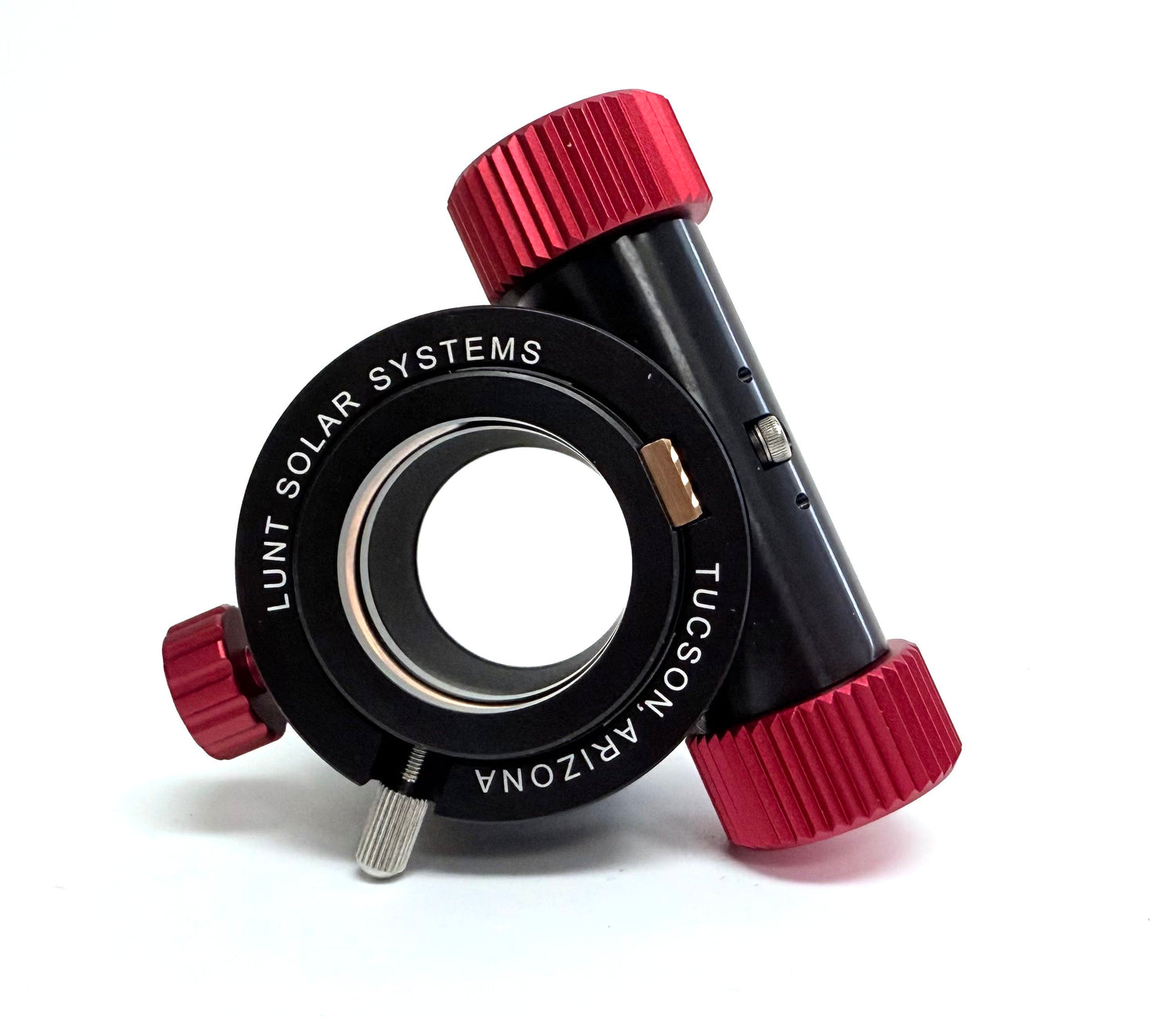


Viewing the Sun in Calcium K — The Magnetic Architecture of Our Star
Share
Most solar observers start with hydrogen-alpha. That's where I'd tell anyone to begin — the chromospheric drama of prominences and filaments is immediately compelling, and pressure-tuned H-alpha instruments are what Lunt Solar Systems is best known for. But there is a second solar wavelength that reveals something H-alpha cannot show you, and once you've seen it, it changes the way you think about the Sun's magnetic structure entirely.
That wavelength is Calcium K — 393.4 nanometres, at the very edge of the visible spectrum on the ultraviolet side. The view it provides is unlike anything else in solar observing.
What Calcium K Actually Shows You
The hydrogen-alpha chromosphere is a layer of energetic, dynamic plasma dominated by magnetic activity at its most dramatic — prominences erupting, filaments threading across the disk, flare events releasing stored magnetic energy. Calcium K shows you something slightly different: the layer of the chromosphere just below the H-alpha layer, slightly cooler, where the magnetic field structure of the Sun is revealed through the brightness of the calcium emission itself.
In Calcium K, the Sun's surface is covered in a cellular network — supergranulation cells whose boundaries glow brightly wherever magnetic field concentrations exist. Active regions surrounding sunspots appear as bright plage — areas of concentrated magnetic flux that stand out dramatically against the quieter surrounding chromosphere. The magnetic skeleton of the Sun becomes visible in a way that H-alpha, for all its drama, does not directly reveal.
Where H-alpha shows you the consequence of magnetic energy — the plasma being pushed, pulled, and accelerated by magnetic forces — Calcium K shows you the magnetic field structure itself, mapped through the response of the calcium plasma. The two wavelengths are complementary in a way that is genuinely scientifically meaningful: observing the same active region in both H-alpha and Calcium K gives you a three-dimensional understanding of its magnetic architecture that neither wavelength alone can provide.
That chromatic image Mark Johnston produced with our LS18CaKD2 diagonal module — the extraordinary purple image of an active region with magnetic structure radiating outward — is Calcium K at its finest. The cellular supergranulation network covers the entire field, and the active region at centre reveals fibril structure and magnetic complexity in genuine detail. That image was taken with a standard customer instrument, not a research observatory.
An Important Note on Visual Observing
I want to be straightforward about something that not every manufacturer discusses openly. The Calcium K wavelength at 393.4nm is at the very edge of what the human eye can detect. Most people can see the violet colour of the wavelength — but resolving the contrast between features requires the eye to detect very fine differences in brightness at a wavelength it struggles with.
The lens of the eye naturally yellows with age, progressively filtering out shorter wavelengths. For many observers over fifty, the visual contrast in Calcium K is significantly reduced — not because the instrument is underperforming, but because the eye is filtering the very wavelength you are trying to observe.
There is a well-known exception: people who have had cataract surgery, in which the natural lens is replaced with an artificial one, often regain access to shorter wavelengths and can see remarkable Calcium K detail visually.
For this reason — and I say this as the person who designed these instruments — Calcium K is primarily an imaging wavelength. Modern CMOS astronomy cameras have no such wavelength sensitivity limitations. They record Calcium K detail with full fidelity, and the images they produce are genuinely spectacular. If you are considering a CaK module primarily for visual use, please contact us first and we will have an honest conversation about what you are likely to see. If you are considering it for imaging — or if you have had cataract surgery — it is an extraordinary addition to any solar observing setup.
The Lunt CaK Module Range
Lunt's redesigned 2026 Calcium K module series delivers a 2.2Å bandpass centred on 393.4nm — a filter stack comprising two interference filters centred on the calcium line, a 2.2Å blocking filter, and a Schott GG385 BBAR filter cemented to the blocking filter for clean out-of-band rejection.
The modules are available in two housing configurations:
S2 — Straight-Through: An inline 2" slide tube for direct camera attachment. The natural choice for dedicated imaging setups. Available in 12mm and 18mm clear aperture.
D2 — Diagonal: A 90° star diagonal housing that allows both visual and imaging use. Available in 6mm, 12mm, and 18mm clear aperture. The diagonal configuration is generally the more versatile choice for observers who want the option of visual use alongside imaging.
For observers using the Lunt 130mm modular telescope, the LS130CaK Herschel wedge module handles the larger aperture through a wedge architecture that manages the heat load that direct filter systems cannot safely accommodate at that aperture.
Selecting the Right Aperture
The CaK blocking filter aperture should be matched to your telescope's focal length. The relationship is straightforward — a longer focal length requires a larger blocking filter aperture to avoid vignetting at the imaging plane.
The 6mm LS6CaKD2 is suited to shorter focal lengths up to approximately 600mm — the Lunt 60mm and 80mm modular telescopes in night configuration, or shorter refractors.
The 12mm LS12CaKS2 and LS12CaKD2 cover telescopes up to approximately 1,200mm focal length — the Lunt 100mm modular telescope and similar instruments.
The 18mm LS18CaKS2 and LS18CaKD2 are for longer focal length systems and full-frame imaging sensors — the Lunt 130mm modular telescope in night configuration is the natural match.
If you are unsure which module is right for your telescope, contact us at sales@luntsolarsystems.com with your telescope's aperture and focal length and we will point you to the correct configuration.
Using CaK with Your Lunt Modular Telescope
If you own a Lunt 60mm, 80mm, 100mm, or 130mm modular telescope, adding a CaK module is straightforward. Remove the H-alpha module and blocking filter — converting the telescope to its night configuration — and attach the CaK module to the focuser. The module is self-contained and includes all necessary internal filters. No additional blocking filter is required.
The ability to observe the Sun in both hydrogen-alpha and Calcium K with a single telescope — and use that same telescope for night-sky observation — is one of the defining advantages of the Lunt modular design. Three disciplines. One instrument.
What CaK and H-Alpha Show You Together
For observers who have both capabilities, the combination is genuinely powerful. Observe an active region in H-alpha and you see the plasma dynamics — filaments, flare activity, the energetic consequences of magnetic reconnection. Switch to Calcium K and you see the magnetic architecture that drives those dynamics — the field concentration in plage, the supergranulation network, the spatial organisation of magnetic flux.
Used together, they provide a depth of understanding of solar magnetic activity that either wavelength alone cannot deliver. I think of them as two instruments that complete each other — and the fact that both are accessible through the same telescope, with the same eyepiece, on the same morning, is something that would have seemed extraordinary to a solar observer thirty years ago.
Getting Started
If you are new to Calcium K observing, the LS12CaKD2 diagonal is the most versatile starting point — compatible with a wide range of focal lengths, usable for both visual and imaging, and available immediately. For dedicated imaging at the highest aperture, the LS18CaKS2 provides the full-frame coverage that serious solar imagers want.
And if you have questions about which module fits your telescope, or about what Calcium K imaging actually looks like through our instruments — contact us. We are a small team in Tucson. We make these instruments and we use them. We will give you a straight answer.
Andy Lunt Founder, Lunt Solar Systems