

Three Ways to Tune a Solar Etalon — And Why Two of Them Have Problems
Share
If you want to observe the Sun in hydrogen-alpha light, you need an etalon — a precisely manufactured optical cavity that transmits only the narrow slice of the spectrum centred at 656.28nm. And if you want to see the chromosphere in its full dynamic range, you need to be able to tune that etalon: shift its centre wavelength slightly to Doppler-shift through the hydrogen-alpha line, following plasma moving toward or away from you on the solar surface.
There are three dominant methods for tuning an air-spaced etalon in consumer solar telescopes. Understanding the physics of each — and the manufacturing requirements each imposes — explains a great deal about why solar telescopes are designed the way they are, and why some design choices are genuinely superior to others.
Other methods exist — including thermal and piezoelectric tuning — but tilt, pressure, and mechanical compression are the three approaches used in virtually all commercially available H-alpha solar telescopes.
I have a particular perspective on this question. Before founding Lunt Solar Systems, I was the lead engineer at Coronado Instruments — the company my father David Lunt founded — where I designed most of Coronado's product line. I worked directly with internal tilt systems, observed their failure modes in detail, and carried that engineering experience with me when I founded Lunt Solar Systems and developed pressure tuning as the solution. That context is directly relevant to everything that follows.
Method 1: Tilt Tuning
An etalon transmits wavelengths that satisfy its resonance condition — wavelengths for which the round-trip optical path length between the two plates is an exact multiple of the wavelength. That path length depends on the gap between the plates, the refractive index of the material in the gap, and the angle at which light passes through.
When you tilt an etalon relative to the optical axis, you change the effective path length for light passing through it. The path length increases with tilt angle, which shifts the centre wavelength toward shorter wavelengths. Tilt a little, shift a little. Tilt more, shift more.
This works beautifully — under one specific optical condition.
The Sun is at a fixed distance of 149.6 million kilometres. For any telescope on Earth, this distance is so vastly greater than the focal length of any instrument that the incoming solar beam is, to all optical purposes, perfectly collimated. Every ray from the Sun arrives at the front of the telescope travelling in exactly the same direction, parallel to every other ray across the full aperture. The incoming beam is not approximately collimated — it is perfectly collimated, to any precision that matters optically. The Sun itself, at its fixed and vast distance, is the most perfect collimator available to an optical engineer. No lens system we can manufacture comes close.
This means a front-mounted etalon — one placed at the entrance of the telescope before the objective — sits in a perfectly collimated beam. Every ray across the full aperture hits the etalon at exactly the same angle. When you tilt the etalon, every ray experiences exactly the same change in path length. The result is a perfectly uniform shift in centre wavelength across the entire aperture. No banding. No aberration. Clean, uniform tuning across the full clear aperture.
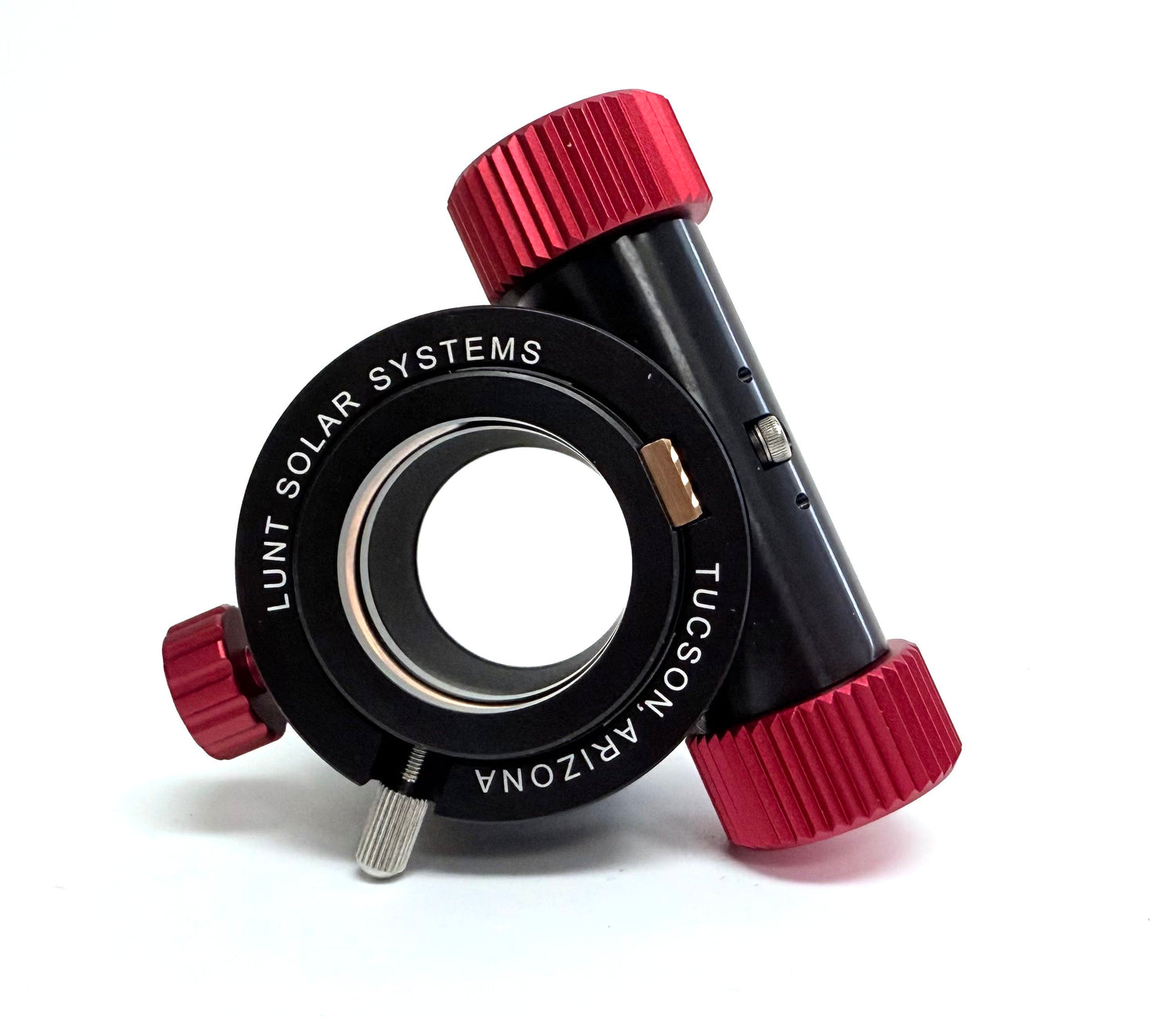
Lunt uses front-mount tilt tuning on all of our external etalon products — the LS40FHa, LS50FHa, LS60FHa, and LS100FHa front-mounted filter series. It works precisely because the beam geometry at the front of the telescope is ideal, and because the Sun itself provides the collimation.
But front-mount tilt tuning has one critical manufacturing requirement: it only works if the etalon's as-manufactured centre wavelength is already close to H-alpha. The wavelength shift achievable by tilt is limited — tilt too far and you introduce aberrations. This means the etalon must land within the achievable tilt range when it comes off the production line. Achieving this requires careful measurement of each coating run, precise spacer selection matched to that coating result, and tight manufacturing control throughout the process.
Lunt plates are polished and spacers are selected to ensure the as-manufactured centre wavelength falls within the tilt range. This is not optional — it is a prerequisite for front-mount tilt to work cleanly. A manufacturer whose production process does not guarantee centre wavelength precision cannot rely on tilt. Some of their etalons would emerge from production so far from H-alpha that no achievable tilt angle in the collimated beam could bring them on-band. For those etalons, tilt is simply not an option.
Why Internal Tilt Was Tried and Abandoned
The logical next question is: can you place a tilt-tuned etalon inside the telescope rather than at the front? This was tried at Coronado, and I was the engineer who worked on it. We understood the problem and we attempted to solve it rigorously. Understanding why we ultimately could not is instructive.
Inside the telescope, behind the objective, the solar beam is no longer collimated — it is converging toward focus. Rays arrive at the internal etalon at a range of angles depending on their position in the beam. Tilting an etalon in this converging beam produces different centre wavelength shifts at different points across the aperture — and the result is banding across the image.
The engineering response at Coronado was to insert a collimating lens set between the objective and the internal etalon — converting the converging beam back to a collimated one before it reached the etalon. In principle this is the right approach. In practice it has a fundamental physical limitation that no engineering effort can fully overcome.
A collimating lens set can only perfectly collimate the axial ray — the single ray travelling exactly along the optical axis. Off-axis rays, which represent every point in the field of view except the exact centre, are only approximately collimated. The quality of that approximation degrades with distance from the axis, meaning collimation is least accurate at the edges of the clear aperture.
The consequence is that even with a carefully designed collimating lens set, the internal etalon sees a beam that is well collimated at centre and increasingly imperfectly collimated toward the aperture edge. Even a small tilt produces a centre wavelength that varies from field centre to field edge. Banding appears. And the usable tilt range before banding becomes objectionable is extremely narrow — far too narrow to provide meaningful Doppler tuning capability across the hydrogen-alpha line. The very feature that makes a solar telescope scientifically valuable — the ability to Doppler-shift through the line and follow plasma motion in real time — was compromised to the point of impracticality.
We abandoned internal tilt at Coronado. Not because the engineering wasn't serious — it was. But because the fundamental physics of off-axis ray collimation sets a limit that no practical lens system can overcome across a useful aperture and tuning range. The front-mounted approach succeeds precisely because it does not need a collimating lens set. The Sun itself provides perfect collimation — uniformly, across the entire aperture, for free — because it is at a fixed and effectively infinite distance. No lens we can manufacture replicates that.
Method 2: Mechanical Compression
If you cannot shift the centre wavelength by tilting — either because the beam geometry makes internal tilt impractical, or because the as-manufactured centre wavelength is too far from H-alpha for tilt to reach — you can instead physically reduce the gap between the etalon plates. Making the gap smaller shifts the centre wavelength. This is mechanical compression tuning.
Sky-Watcher's Heliostar series uses this approach. Their "Trifid Tuner" applies mechanical force to the etalon assembly through a central contact point. On their own product page, Sky-Watcher describes it accurately: the Trifid Tuner "applies physical pressure to the etalon plates allowing the observer to reach the desired Hydrogen emission line."¹
Mechanical compression has one significant advantage over tilt: it offers a much wider tuning range. Where front-mount tilt can only shift the centre wavelength by a limited amount before introducing aberrations, compression can shift it through a much larger range — potentially through the entire Free Spectral Range of the etalon. This wide range has a direct production implication that is worth stating plainly.
A manufacturer using mechanical compression does not need to match spacer thickness to the coating run. They can assemble an etalon at whatever centre wavelength it happens to land at and compress it to H-alpha regardless. This eliminates one of the most demanding and expensive steps in precision etalon manufacturing — the measurement, characterisation, and spacer-matching process that precision tilt-tuned production requires. It is a production cost optimisation. It is not a performance optimisation.
The Physics of Center-Point Loading
Mechanical compression introduces a physics problem that neither tilt nor pressure tuning share.
When you apply force to the centre of a plate while supporting it at the edges, you do not compress it uniformly — you bend it. The centre deflects inward while the edges, supported by peripheral spacers, move less. The result is a gap that is smaller in the centre than at the edges — a non-parallel cavity whose degree of non-parallelism increases with the compression applied.
A non-parallel cavity has direct and measurable optical consequences. The centre wavelength varies across the aperture — the centre of the field is tuned to a slightly different wavelength than the edges. This produces the "sweet spot" behaviour that owners of compression-tuned systems learn to accommodate: the view is optimised in the portion of the field where the gap happens to produce the desired wavelength, and contrast degrades toward the edges. The effective bandpass also broadens, because the instrument simultaneously transmits slightly different wavelengths at different field positions. The measured bandpass is a convolution of the etalon's intrinsic bandwidth and the gap non-uniformity — and it is wider than the intrinsic bandwidth alone.
An independent technical review of the Sky-Watcher Heliostar on Cloudy Nights acknowledged this directly: excessive centre-only compression "can result in a broadening of the etalon's bandpass and decreased contrast levels."²
Why a Centre Foot Exists at All
The centre foot design — the central contact point through which compression force is applied — has a history I can speak to directly, having worked with it at Coronado.
It was not a performance feature. It was a manufacturing accommodation for plates that were not perfectly flat. If the etalon plates have residual curvature — if they are slightly high or low in the centre relative to the edges — the centre foot provides a mechanism to apply differential correction by pushing or pulling at the centre point. In other words: the centre foot is a compensating mechanism for plates whose flatness is insufficient for uniform peripheral contact without mechanical assistance.
Lunt plates are polished to the precision required for uniform peripheral contact without mechanical correction. We do not use a centre foot because our manufacturing standards make it unnecessary.
The Long-Term Concern: Optical Contact Fatigue
In the Sky-Watcher implementation, the centre contact point is optically bonded to the etalon plates. Optical contact — molecular adhesion between two clean, flat surfaces through Van der Waals forces — is a well-established and reliable technique for static applications. The bond is highly effective when the surfaces are not moving relative to each other.
The Trifid mechanism subjects this bond to cyclic loading. Every tuning adjustment applies force to the centre of the assembly. The bonded interface flexes under load and recovers when the load is released. Every observing session, every Doppler shift through the hydrogen-alpha line, every adjustment made to follow changing solar features — each one is a cycle of load and release on that contact bond.
Materials science literature documents what happens to adhesive bonds under cyclic stress. Delamination — gradual failure of the molecular bond — develops internally without surface evidence, analogous to metal fatigue.³ Research into bonded optical assemblies under cyclic loading has documented crack initiation at bonding interfaces after repeated stress cycles, with failure progressing invisibly until the bond can no longer maintain the required optical relationship.⁴
The question is not whether cyclic loading will eventually degrade the optically contacted centre foot — it is when. A solar telescope used regularly over years of active observing accumulates thousands of tuning cycles. The optical contact bond was designed for static applications. It was not designed for this. When the contact begins to fail, the etalon gap becomes undefined, the centre wavelength becomes unstable, and the system fails — not gradually, but catastrophically and irreversibly.
Lunt pressure-tuned etalons have no such failure mode. There is no centre foot. There is no optical contact subject to cyclic mechanical stress. There is nothing that accumulates damage with use.
Method 3: Pressure Tuning
The third method changes neither the physical gap nor the tilt angle. Instead it changes the refractive index of the air inside the etalon cavity.
The resonance condition for an etalon depends on optical path length — the physical gap multiplied by the refractive index of the material in the gap. Air has a refractive index very close to 1.0, but that index changes predictably with pressure. Seal the etalon inside a pressurised cavity and change the air pressure, and you change the refractive index of the air, which changes the optical path length, which shifts the centre wavelength — without touching the etalon, without changing the gap, without applying any mechanical force to the optical surfaces.
This is Lunt's internal approach, and it is my own design — developed after founding Lunt Solar Systems, drawing directly on the lessons of what I had seen fail at Coronado. Every Lunt telescope uses a sealed pressure-controlled cavity. The tuning knob adjusts air pressure inside that cavity. Nothing touches the etalon.
The geometrical elegance of pressure tuning is that it is completely immune to beam geometry. Changing air pressure affects the refractive index uniformly throughout the entire sealed cavity. Every ray — regardless of its angle, regardless of whether the beam is collimated or converging — experiences exactly the same change in optical path length. There is no banding. No field-position dependence. No sweet spot. No collimation requirement. The limitation that made internal tilt impractical — the impossibility of perfectly collimating off-axis rays — simply does not apply, because pressure tuning does not depend on beam geometry at all.
The sealed cavity also makes the system completely altitude-insensitive. Ambient atmospheric pressure has no effect on the sealed internal pressure. A Lunt telescope performs identically at sea level and at altitude. Weather-driven barometric changes during a session cause no centre wavelength drift. You tune once and the instrument stays tuned until you choose to change it.
And because the tuning mechanism applies no mechanical force to the etalon, there is no stress on the optical surfaces, no cyclic loading, and no contact fatigue. The etalon floats on small silicone isolation pads inside the sealed cavity, thermally and mechanically decoupled from the chamber walls. The chamber can expand and contract with temperature while the etalon floats undisturbed. The tuning mechanism has no moving parts in contact with the optic — because it does not need any.
Historical Context
My father David Lunt founded Coronado Instruments, and I was the lead engineer there for the years that established dedicated solar telescopes as a serious category of astronomical instrument. We tried internal tilt seriously — with proper collimating lens sets, with real engineering effort — and I documented its limitations firsthand. Coronado used mechanical compression in a number of its products, and I observed those failure modes as well.
When Coronado was sold to Meade Instruments following my father's illness and passing, I founded Lunt Solar Systems with a clear engineering objective: to solve the problems I had spent years observing. Pressure tuning was the solution I developed — sealing the etalon in a pressure-controlled cavity, changing the refractive index of the air rather than the geometry of the optic, and eliminating mechanical contact with the optical element entirely. The pressure tuning patent was filed by Lunt Solar Systems and represented a genuine architectural advance over everything that had come before.
An independent reviewer on Cloudy Nights noted that the Sky-Watcher Heliostar "was made possible with the expiration of the original Coronado patented tuning method developed by David and Andy Lunt, et al."² This attribution is not entirely accurate — pressure tuning was my own invention at Lunt Solar Systems, not a Coronado development — but the core observation is correct. The Heliostar's mechanical compression approach became commercially viable when the Lunt pressure tuning patent expired. It is not a new innovation. It is a return to the older methodology that pressure tuning was specifically designed to supersede — now viable again not because it has been improved, but because the intellectual property protecting the better approach has expired.
I do not say this to be dismissive of Sky-Watcher's engineering. The Heliostar is a real product that real observers are enjoying. But the underlying tuning architecture is one I know intimately — not from competitive analysis, but from years of direct engineering experience with its limitations. The bandpass broadening from centre-point loading is real. The optical contact fatigue concern is real. The altitude sensitivity of unsealed compression systems is real. These are not theoretical criticisms. They are the reasons I designed something different.
Summary
Three tuning methods exist for solar etalons. Front-mount tilt works in the perfectly collimated solar beam — the Sun at its fixed distance provides ideal collimation that no lens system can replicate — but requires precision manufacturing to ensure the as-manufactured centre wavelength is within the achievable tilt range. Internal tilt with a collimating lens set was tried at Coronado with serious engineering effort and abandoned because no practical lens can perfectly collimate off-axis rays, leaving the usable tuning range too narrow for meaningful Doppler capability. Mechanical compression offers a wide tuning range and forgives imprecise centre wavelength manufacturing, but produces non-uniform gap, broadened bandpass, sweet-spot viewing, and long-term optical contact fatigue risk. Pressure tuning is geometrically immune to beam angle, altitude-insensitive, applies no mechanical force to the etalon, and has no fatigue failure mode.
Lunt uses front-mount tilt tuning on external etalons — where the Sun's perfectly collimated beam makes it the ideal solution — and pressure tuning on all internal systems. We do not use mechanical compression because our manufacturing precision makes it unnecessary, and because its long-term failure mode is one I have seen up close and am not willing to pass on to our customers.
¹ Sky-Watcher USA, Heliostar 76mm H-Alpha Solar Telescope product page, skywatcherusa.com ² Cloudy Nights, "Review of the Sky-Watcher Heliostar 76 Hydrogen-Alpha Solar Telescope," cloudynights.com, October 2025 ³ Delamination failure in adhesive bonds under cyclic loading — materials science literature ⁴ Cyclic fatigue effects on optically bonded assemblies — optical engineering literature
About the Author
Andy Lunt is the founder of Lunt Solar Systems and the inventor of the pressure-tuned solar etalon system that defines the modern dedicated solar telescope. Before founding Lunt Solar Systems, Andy was the lead engineer at Coronado Instruments — the company founded by his father, David Lunt — where he designed most of Coronado's product line and worked directly on the internal etalon architectures described in this article. After Coronado's sale to Meade Instruments following his father's passing, Andy founded Lunt Solar Systems and invented pressure tuning as the solution to the etalon design problems he had lived through firsthand. He holds the original IP on pressure-tuned solar etalon systems and has over 25 years of experience in Fabry-Pérot etalon design and manufacture.