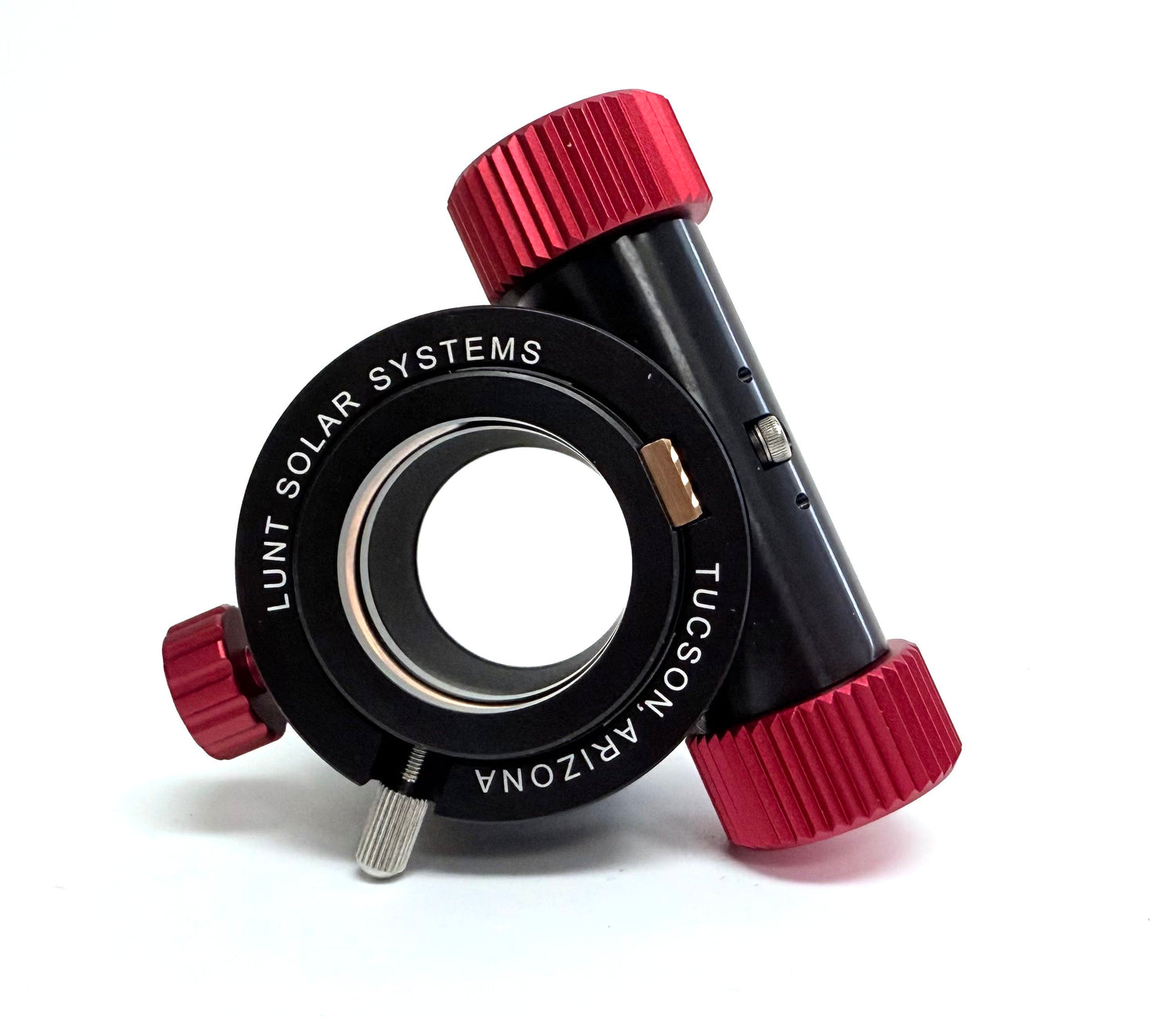


The Paradox of the Stiff Mount — Why Rigid is the Wrong Goal in Precision Optics
Share
When people think about precision optical instruments, they tend to think about rigidity. A stiff mount. A solid structure. No flex, no movement, no give. It seems obvious: if you want optical components to stay exactly where you put them, you make the mount as rigid as possible.
This intuition is wrong. And in precision etalon design, it leads directly to performance degradation that is real, measurable, and entirely avoidable.
Understanding why rigidity is the wrong goal — and what the right goal actually is — requires a short excursion into optomechanical engineering. The principles are well established in the academic and industrial literature. Their implications for solar etalon design are profound.
Six Degrees of Freedom and the Kinematic Ideal
Any rigid body in space has exactly six degrees of freedom — three translational (movement along x, y, and z axes) and three rotational (rotation about those same axes). A perfectly designed optical mount constrains exactly those six degrees of freedom — no more, no fewer. This is the kinematic ideal.
As documented in optomechanical engineering literature from the University of Arizona's optical sciences curriculum, when a movement in any particular degree of freedom is prevented by more than one mechanism, the body is overconstrained. The result is that the constraints fight each other — some become ineffective, or the body is deformed by the conflicting constraints, and the loads on the optical element become indeterminate.¹
The phrase "loads become indeterminate" is the critical one. It means the mechanical forces acting on the optical element cannot be predicted or controlled — they depend on manufacturing tolerances, assembly conditions, temperature, and other variables that change from unit to unit and from day to day. An overconstrained optic is at the mercy of its mount.
As the Newport Corporation's optical mount technology guide summarises, the advantages of a kinematic mount include increased stability and — critically — distortion-free optical mounting.² Distortion-free. That is the goal. Not rigidity. Not stiffness. The absence of distortion.
Why Mechanical Tolerances Are the Enemy of Optical Precision
The fundamental problem with rigid mechanical mounting of precision optics is the enormous gap between mechanical and optical tolerances.
Precision machined mechanical components are manufactured to tolerances of roughly 0.001 inches — about 25 micrometres — at best. Precision optical surfaces are polished to tolerances measured in nanometres. The Lunt Zygo Verifire interferometer, which we use to verify our etalon plate flatness, works to sub-nanometre precision. The gap between mechanical and optical tolerances is approximately three orders of magnitude — mechanical components are roughly 1,000 times less precise than the optical surfaces they are supposed to control.
When you rigidly constrain a precision optical element in a mechanical mount, you are coupling a nanometre-precision optic to a micrometre-precision structure. Every imperfection in the mechanical components — every tolerance stack, every surface finish variation, every assembly inconsistency — is transmitted directly to the optical element. The optic becomes a slave to the limitations of the mechanical system surrounding it.
Standard set-screw mounts and rigid mechanical constraints often create localised stress points in optical elements. RP Photonics These stress points are not uniform across the optical surface — they are concentrated at the contact locations, creating a non-uniform stress distribution that varies across the aperture.
Stress Birefringence: When Mechanical Stress Becomes Optical Error
When mechanical stress is applied to optical glass, it does something that most observers would not expect: it changes the refractive index of the glass. This is stress birefringence — a well-documented phenomenon in precision optics with direct consequences for optical performance.
Stress-induced birefringence is a widespread and often unavoidable problem in optical systems, occurring in glass lenses as a result of poor optomechanical mounting techniques. Optical materials can undergo strain at the molecular level due to external pressures, vibration, or temperature change. This stress-induced retardance is undesirable, changing the wavefront aberration and polarisation aberration, and affecting the point spread function of optical systems. Taylor & Francis
For an etalon — which depends on precisely controlled optical path length through the cavity — any change in the refractive index of the plate material from mechanical stress directly affects the performance of the instrument. The centre wavelength shifts. The bandpass profile changes. The uniformity across the aperture degrades. And none of this is visible from the outside of the instrument — the etalon looks the same, the mount looks the same, but the optical performance is subtly and unpredictably compromised.
For precision and astronomical optics, the permissible optical path difference from stress is less than 5 nanometres per centimetre. Laser Focus World This is an extraordinarily tight tolerance — and it illustrates why the mechanical stress introduced by rigid mounting or mechanical compression is not a theoretical concern but a practical one with real consequences at the performance levels serious solar observers require.
The CTE Mismatch Problem
Rigid mounting creates a second problem that compounds the stress birefringence issue: differential thermal expansion.
Different materials expand at different rates when heated. Aluminium — the most common material for telescope housings and mechanical components — has a coefficient of thermal expansion (CTE) of approximately 23.6 parts per million per degree Celsius. Steel is approximately 12 ppm/°C. Fused silica — the material used for precision etalon plates — has a CTE of approximately 0.55 ppm/°C.
The difference between aluminium and fused silica is more than 40 to one. A temperature change that causes an aluminium housing to expand by 23.6 micrometres per metre per degree causes the fused silica etalon plate to expand by only 0.55 micrometres over the same distance and temperature change. If the etalon plate is rigidly constrained by an aluminium structure, the aluminium tries to expand while the fused silica resists. The result is mechanical stress applied to the optical element — stress whose magnitude depends on the temperature change, the CTE mismatch, and the rigidity of the constraint.
CTE mismatches between optical glasses and mounting materials induce stress in optical elements over operational temperature ranges, creating performance degradation in precision optical systems. ResearchGate For a solar telescope that is used outdoors across a range of temperatures — from cool morning setup to warm midday observing, from temperate climates to the temperature extremes of eclipse travel — this thermal stress is not a design edge case. It is a routine operational condition.
A rigid mount that introduces zero stress at 20°C introduces real, measurable stress at 10°C and at 30°C. The instrument that performs well on a cool morning may perform differently at midday. And the stress is not uniform — it is concentrated at the constraint points, producing the non-uniform stress distribution that stress birefringence analysis reveals as wavefront error across the aperture.
The Lunt Approach: Floating, Not Constraining
The solution to all of these problems — overconstrained mounting, mechanical tolerance coupling, stress birefringence, CTE mismatch — is the same: minimise the mechanical coupling between the optical element and its mount.
The ideal etalon support applies exactly the constraints needed to keep the etalon in place during shipping and handling, and removes all mechanical influence from the etalon during use. These two requirements seem contradictory — you need to hold it, but you need to not touch it. The answer is compliance: a support material that is stiff enough to survive handling loads but compliant enough to absorb differential thermal expansion without transmitting stress to the optical element.
Specialised stress-free mounts employ techniques such as three-point contacts with weak forces, retaining rings with elastic spacers, or adhesive bonding with compliant materials to hold the optic gently but securely. RP Photonics
Lunt etalons are supported on small silicone isolation pads inside the sealed pressure cavity. Silicone has a very low elastic modulus — it is highly compliant. When the aluminium chamber expands with temperature, the silicone pads compress slightly rather than transmitting the expansion as stress to the fused silica plates. The etalon floats — mechanically decoupled from the housing, thermally decoupled from the chamber walls, isolated from vibration during transport.
During operation, the tuning mechanism — air pressure — applies its effect uniformly throughout the entire sealed cavity. It does not touch the etalon. It does not create contact stress. It does not introduce localised loading at any point on the optical surfaces. The etalon experiences the pressure change as a uniform change in the refractive index of the air surrounding it — exactly the condition it was designed to operate in.
What "Stiff" Actually Means for the Heliostar
Sky-Watcher's marketing for the Heliostar Trifid Tuner describes the three-vane support structure as providing "secure tuning for the etalon without stressing any peripheral systems." The intent is to convey mechanical stability. The engineering reality is more complex.
The Trifid mechanism constrains the etalon through a central contact point and three support veins. This is a rigid mechanical linkage between the etalon and the surrounding structure. Every temperature change that causes differential expansion between the aluminium housing and the fused silica plates is transmitted through that linkage as stress. Every manufacturing tolerance in the mechanical components — the vane geometry, the contact point dimensions, the housing concentricity — becomes a source of non-uniform load on the optical element.
The system is not isolated from these effects. It is directly coupled to them. And because the coupling is through a rigid structure rather than a compliant one, the loads are transmitted rather than absorbed.
This is the paradox of the stiff mount: the rigidity that appears to provide stability is actually the mechanism through which mechanical imperfection and thermal variation are transmitted to the optical element. A compliant mount that appears less stable actually provides better optical isolation precisely because it absorbs rather than transmits these disturbances.
Why This Matters at Sub-Half-Angstrom Bandwidths
At the bandwidths involved in serious solar observation — 0.45Å single stack, less than 0.28Å double stack — the optical path length through the etalon cavity must be controlled to extraordinary precision. The H-alpha wavelength is 656.28nm. A bandpass of 0.45Å is 0.045nm — approximately one part in 14,600 of the wavelength. Controlling the optical path length to this precision across the full aperture, across a range of temperatures, across thousands of operating hours, requires that the mechanical mount introduce essentially no distortion to the optical element.
This is not achievable with a rigid, overconstrained mount in the presence of CTE mismatches measured in tens of parts per million per degree. It is achievable with a compliant, kinematically sound mount that isolates the optic from its mechanical environment.
The Lunt silicone pad support, inside a sealed pressure cavity, is the practical implementation of this principle. It is not the most intuitive design — a floating etalon sounds less controlled than a rigidly constrained one. But the physics is clear: isolation from mechanical disturbance produces better and more consistent optical performance than rigid coupling to a mechanical structure that is inherently less precise than the optic it surrounds.
Summary
Rigid mounting of precision optics is not a virtue — it is a liability. Overconstrained mounts transmit mechanical imperfections and thermal disturbances directly to the optical element. CTE mismatches between aluminium housings and fused silica etalon plates generate real mechanical stress with every temperature change. Stress birefringence converts that mechanical stress into optical path length error across the aperture. The correct engineering goal is not rigidity but isolation — a kinematically sound, compliant mount that constrains the optic exactly as needed and no more.
Lunt etalons float on silicone isolation pads inside sealed pressure cavities. The tuning mechanism applies no mechanical force to the optical element. The mount absorbs thermal disturbance rather than transmitting it. The result is consistent, uniform optical performance across the full aperture, across the operational temperature range, across the life of the instrument.
¹ University of Arizona OPTI521, "Tutorial on Kinematic Constraints," optical sciences curriculum ² Newport Corporation, "Optical Mirror Mount Technology Guide," newport.com ³ Laser Focus World, "Optical Mounts: Stress-free mounting enables diffraction-limited performance," laserfocusworld.com ⁴ Chipman, R., Lam, W.T., Young, G., "Stress-Induced Birefringence," Chapter 25, Polarized Light and Optical Systems, Taylor & Francis, 2018 ⁵ Doyle, K.B., "Stress Birefringence Modeling for Lens Design and Photonics," Sigmadyne / ResearchGate
Next in this series: "The Hidden Failure Mode — Optical Contact Fatigue and What It Means for Your Etalon"
About the Author
Andy Lunt is the founder of Lunt Solar Systems and the inventor of the pressure-tuned solar etalon system that defines the modern dedicated solar telescope. Before founding Lunt Solar Systems, Andy was the lead engineer at Coronado Instruments — the company founded by his father, David Lunt — where he designed most of Coronado's product line and worked directly on the internal etalon architectures described in this series. After Coronado's sale to Meade Instruments following his father's passing, Andy founded Lunt Solar Systems and invented pressure tuning as the solution to the etalon design problems he had lived through firsthand. He holds the original patent on pressure-tuned solar etalon systems and has over 25 years of experience in Fabry-Pérot etalon design and manufacture.