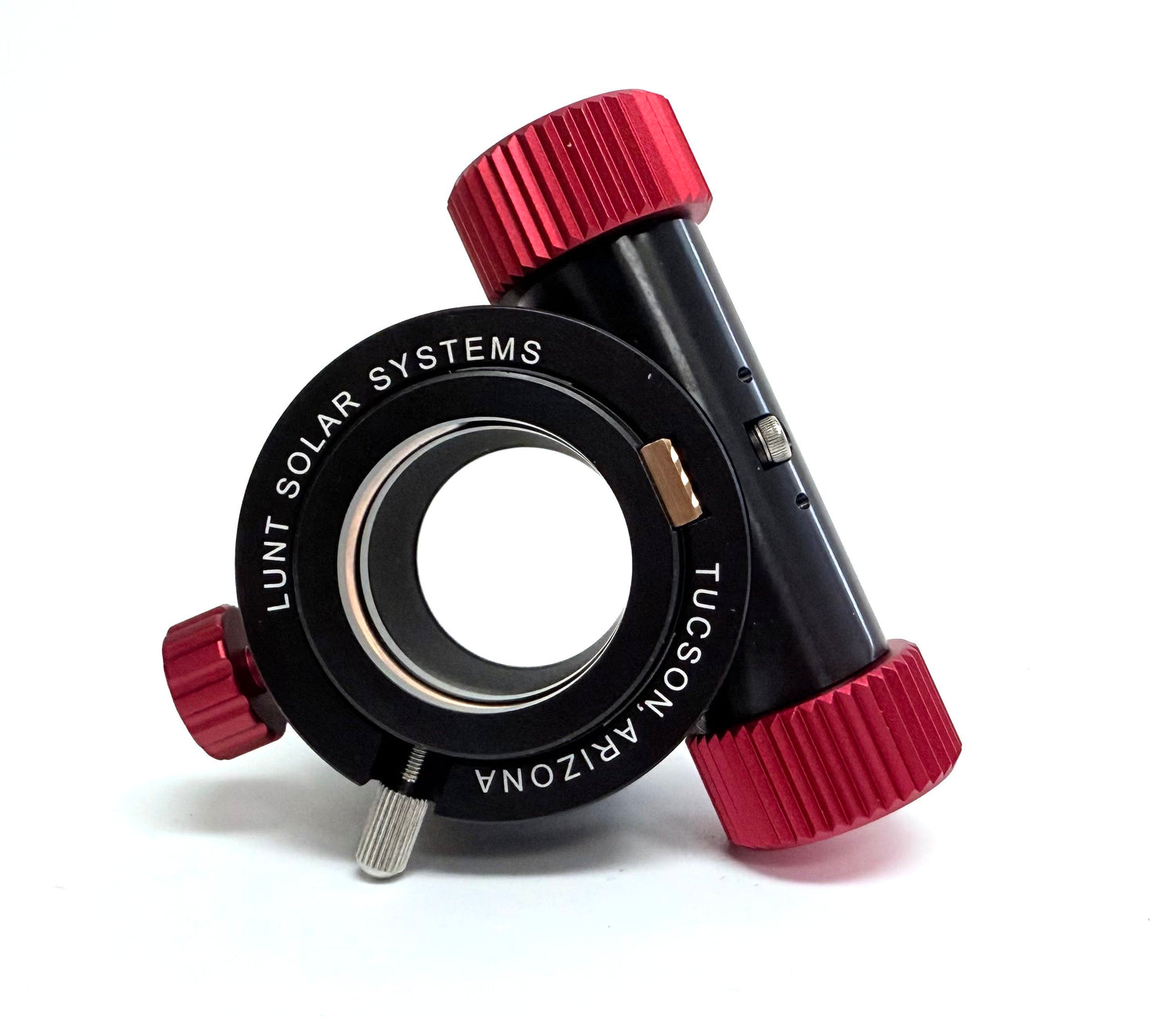


The Hidden Failure Mode — Optical Contact Fatigue and What It Means for Your Etalon
Share
Most optical failures are visible. A scratched lens. A fogged coating. A cracked element. You can see the problem, diagnose it, and make a decision about repair or replacement.
The failure mode I want to discuss in this post is different. It develops invisibly, inside a sealed optical assembly, over hundreds or thousands of operating cycles. It produces no external sign until the moment it becomes severe enough to affect performance — and by that point, the damage is done. There is no repair. The etalon is compromised.
It is called optical contact fatigue, and it is a direct consequence of applying cyclic mechanical loads to an optically bonded interface. Understanding it requires understanding what optical contact is, why it is used, and what happens when it is subjected to loads it was not designed to bear.
What Optical Contact Is
Optical contact — sometimes called wringing — is a bonding technique in which two extremely flat, clean glass surfaces are brought into contact and held together by molecular adhesion. No adhesive is used. The bond forms through Van der Waals forces between the glass molecules at the two surfaces — the same intermolecular forces that cause precision gauge blocks to stick together in metrology applications.
Optical contact is a genuinely remarkable technique. A well-executed optical contact bond is optically continuous — light passes through the interface as though the two pieces of glass were a single element, with no reflection loss or wavefront disturbance at the joint. It is strong enough for many demanding applications. It is the bonding method of choice wherever an adhesive-free, optically clear joint is required.
But optical contact has a critical design constraint that is well understood in precision optics engineering: it is a static bonding technique. The bond relies on intimate surface contact maintained by intermolecular forces across the entire bonded area. Those forces are strong in compression and shear under static conditions. Under cyclic loading — repeated application and release of mechanical stress — they are considerably less robust.
The Centre Foot and Cyclic Loading
In the Sky-Watcher Heliostar's Trifid tuning mechanism, the central contact point — the centre foot — is optically contacted to the etalon plates. This foot is the point through which the Trifid mechanism applies compression force to tune the etalon. Every time the observer adjusts the tuner, the following sequence occurs:
Force is applied through the three-vane Trifid structure to the centre foot. The foot transmits that force to the centre of the etalon plate. The plate flexes slightly — bowing inward at the centre while the edges remain supported by the peripheral spacers. The optical contact interface between the foot and the plate experiences shear and tensile stress at its boundary — the point where the bonded area transitions to unbonded glass. When the tuner is released or adjusted in the opposite direction, the load reverses. The plate relaxes. The interface experiences stress in the opposite direction.
This is a textbook cyclic loading scenario applied to an optical contact bond.
What Cyclic Loading Does to Bonded Interfaces
Materials science and structural engineering literature is extensive on what happens to bonded interfaces under cyclic loading. The fundamental finding is consistent across decades of research: bonds that survive static loading without issue can fail progressively under cyclic loading at stress levels well below their static strength.
Fatigue cycling progressively grows existing delaminations under cyclic interlaminar loading. Infinita Lab The key word is "progressively" — the failure does not happen suddenly at a threshold cycle count. It grows. Micro-scale damage accumulates with each cycle, extending existing microscopic imperfections at the bond boundary until they reach a size where the bond can no longer maintain the required optical relationship.
Under the periodic nature of applied load, micro-cracks initiate and propagate at relatively low stress levels, gradually accumulating until the structure fractures. Cyclic loading is a common cause of bond failure and negatively affects service life. nih
For an optical contact bond specifically, the failure mechanism is delamination — the progressive separation of the two bonded surfaces beginning at the bond boundary and propagating inward. After 1000 cycles, many cracks were found in the centre of bonding interfaces under cyclic loading conditions, indicating that mechanical fatigue was the primary reason for initial crack formation. PubMed Central
One thousand cycles. A solar observer who uses their telescope regularly, adjusting the Trifid tuner several times per session, might accumulate that many tuning cycles within a few years of normal use. The number is not a distant horizon — it is within the normal service life of a telescope that a committed observer will use regularly.
The Insidious Nature of Optical Contact Failure
What makes this failure mode particularly concerning for etalon users is its invisibility.
Delamination is an insidious kind of failure as it develops inside the material without being visible on the surface, much like metal fatigue. Infinita Lab An etalon with early-stage delamination at the centre foot contact looks identical from the outside to a healthy etalon. The housing is unchanged. The external mechanism operates normally. The tuner still turns. There is no rattle, no visible crack, no obvious sign of distress.
What changes is optical performance. As the delamination grows, the centre foot loses intimate contact with the etalon plate over an increasing area. The mechanical coupling between the foot and the plate becomes inconsistent — force is transmitted through the remaining bonded area rather than the full contact footprint. The load distribution across the plate changes. The gap uniformity degrades further. The bandpass broadens. Contrast decreases.
The observer notices that the view is not quite as sharp as it used to be. Chromospheric contrast seems slightly reduced. The sweet spot — already present in a compression-tuned system, as discussed in Post 1 — seems to have moved or shrunk. They adjust the tuner, trying to recover the view they remember. Each adjustment is another cycle on the degrading bond.
In the final stage, the optical contact fails completely. The centre foot detaches from the plate. The etalon gap is no longer controlled by the compression mechanism in any predictable way. The telescope that was producing acceptable solar views is now producing a random, uncontrolled bandpass. The instrument has failed — not because of any manufacturing defect, not because of misuse, but because a static bonding technique was subjected to cyclic mechanical loading over years of normal operation.
The Question of When, Not If
I want to be precise about the claim I am making here, because precision matters.
I am not claiming that every Heliostar will fail within a specific number of years. I do not have access to Sky-Watcher's engineering specifications for the optical contact, the load per tuning cycle, or the fatigue life calculations they may or may not have performed. Any specific failure timeline would be speculative.
What I am claiming — and what the materials science literature clearly supports — is that cyclic loading of an optical contact bond will eventually degrade that bond. The rate of degradation depends on the load per cycle, the quality of the original contact, the temperature environment, and other variables. But the direction of travel is one way: every cycle accumulates some damage, however small. There is no mechanism by which cyclic loading repairs or strengthens an optical contact bond.
Delamination growth due to cyclic loading generally occurs at maximum load levels that are lower than those required to cause growth under quasi-static loading. ResearchGate In other words, the cyclic loading that occurs during normal tuning — loads that the contact could survive indefinitely if applied once and never repeated — is sufficient to grow delamination over time simply because it is repeated.
The question for any observer purchasing a compression-tuned etalon system is not whether this failure mode exists. It exists. The question is whether the expected service life of the instrument, under their pattern of use, is acceptable given that the primary tuning mechanism is systematically degrading its optical bond with every adjustment.
Variable Force Across the Production Run — Unpredictable Fatigue Life
There is an additional dimension to the fatigue concern that deserves direct attention: the compression force required to bring a given Heliostar etalon to H-alpha is not consistent across the production run — and the buyer has no way of knowing what force their specific unit requires.
Because Sky-Watcher assembles etalons across a wide manufacturing centre wavelength window and relies on the Trifid mechanism's compression range to bring each unit to H-alpha, individual units require very different amounts of compression depending on where their as-manufactured CWL happened to land. An etalon that came off the production line close to H-alpha requires only modest compression — low force, low stress per tuning cycle, and a fatigue life that may be considerably longer than average. An etalon that landed far from H-alpha requires substantially more compression to reach the same operating point — higher force, higher stress at the optical contact interface, and a fatigue trajectory that is correspondingly steeper.
Two observers purchasing identical Heliostar 76 instruments on the same day may have units with fundamentally different long-term durability. Not because of any quality control failure, not because either unit is defective, but simply because the etalons happened to land at different positions within the manufacturing CWL window. The external appearance is identical. The specifications listed are identical. The force applied to the optical contact interface every time the tuner is adjusted may be substantially different — and neither observer knows which situation they have.
This unpredictability is not a secondary concern. It means that the fatigue life of a compression-tuned etalon is not a property of the design class that can be characterised and communicated to buyers — it is a property of each individual unit, determined by the manufacturing CWL lottery and never measured or disclosed.
Altitude Changes the Force Required — Compounding the Fatigue Problem
The altitude sensitivity discussed in Post 2 of this series has a direct mechanical consequence that belongs in this discussion of fatigue.
An open-cavity compression-tuned etalon assembled and calibrated at sea level has its gap set for sea-level atmospheric conditions. The higher refractive index of air at sea-level pressure contributes to the optical path length, and the compression required to reach H-alpha reflects this. At altitude, ambient pressure drops, the refractive index of the gap air decreases toward its vacuum value, and the CWL shifts away from H-alpha. To bring the etalon back on-band, the observer must apply additional compression — physically reducing the gap further to compensate for the reduced refractive index contribution.
This additional compression is not a tuning preference. It is a physical requirement imposed by altitude. And it means that an observer using a sea-level-calibrated compression telescope at 10,000 feet is applying greater mechanical force to the optical contact interface than at sea level — not because of anything they did wrong, but because altitude physics demand it.
The inverse situation is equally problematic. An etalon calibrated at altitude has its gap set for the lower refractive index of air at reduced pressure. At sea level, the higher refractive index shifts the CWL away from H-alpha in the opposite direction. To compensate, substantially more compression may be required — pushing the mechanism toward the upper end of its force range and increasing the per-cycle stress on the optical contact accordingly.
The 2026 eclipse presents exactly this scenario at scale. Observers travelling from sea-level calibration environments to elevated sites in the Pyrenees or on Icelandic plateaus will be operating their compression-tuned systems outside the conditions under which they were set up. Every retuning adjustment at altitude applies greater force to the optical contact interface than the same adjustment at sea level. The fatigue accumulation rate is higher — not by design intent, but as a direct physical consequence of the open-cavity architecture and altitude-driven refractive index change.
The Trifid Pin Placement — Accommodation, Not Solution
Sky-Watcher designed the Trifid mechanism with user-adjustable pin placement. The observer can select from different positions that change the mechanical advantage and therefore the force range available. A pin placement providing greater mechanical advantage increases the compression range — useful for etalons that require more force to reach H-alpha, or for compensating for altitude-driven CWL shift. A reduced mechanical advantage provides finer control for units requiring less compression.
The existence of this adjustability is itself an acknowledgement of the variability the system must accommodate. Different production units require different force ranges because they were assembled at different points in the manufacturing CWL window. Different observing locations require different force ranges because altitude changes the compression required to reach H-alpha. The adjustable pin placement is a user-accessible compensation mechanism for both sources of variability.
But adjusting the pin placement changes only the force range available to the observer. It does not change any of the underlying physics. The gap non-uniformity from centre-point loading remains. The cyclic stress on the optical contact interface remains. The altitude sensitivity of the open cavity remains. The production variability in per-unit fatigue life remains. The pin placement is a thoughtful engineering accommodation to real operational challenges — but it does not resolve those challenges. It manages them within the constraints of an architecture that introduces them in the first place.
The Root Cause: Compression as Manufacturing Workaround
It is worth being direct about what the compression system actually represents, because Sky-Watcher's marketing presents it as a deliberate design choice rather than what it actually is in engineering terms.
The Trifid compression mechanism exists because Sky-Watcher's manufacturing process produces etalons across a wide centre wavelength window — wide enough that tilt, even in a nearly collimated beam, cannot bring all units to H-alpha. The wide compression range of the Trifid is not a feature. It is a requirement imposed by the width of the manufacturing CWL window it must compensate for. The adjustable pin placement is not a sophisticated user control — it is a field compensation for the per-unit variability that the manufacturing process produces.
Compression tuning is a solution to a production problem. It is not a performance optimisation. No serious optical engineer, given a genuine choice between pressure tuning and mechanical compression for an internal etalon system, would choose compression. Pressure tuning produces a more uniform optical path across the aperture, introduces no mechanical stress to the optical elements, has no cyclic fatigue failure mode, and is altitude-insensitive. The only reason to choose compression is if you lack the manufacturing capability to guarantee a CWL close enough to H-alpha for tilt, and lack the architectural investment in a sealed pressure cavity.
Sky-Watcher is a capable manufacturer of astronomical instruments. The Heliostar produces real solar views that real observers are enjoying. But the underlying tuning architecture is a workaround for a manufacturing constraint — implemented at the cost of optical uniformity, long-term reliability, and consistency across the production run. These are engineering facts that any buyer making a significant investment in a solar telescope deserves to understand.
Why Lunt Has No Centre Foot
The Lunt approach eliminates this entire family of problems by design rather than by managing them.
Lunt etalons have no centre foot. There is no optically contacted element that serves as the mechanical interface for tuning. The tuning mechanism — air pressure — applies its effect by changing the refractive index of the air throughout the sealed cavity. It does not touch the etalon. There is no mechanical coupling between the tuning mechanism and the optical surfaces.
The etalon plates float on small silicone isolation pads inside the sealed pressure cavity. The silicone contacts the edges of the etalon assembly, not the optical surfaces. The contact is compliant — it absorbs rather than transmits mechanical disturbance. There is no rigid contact point, no optically bonded interface subject to tuning loads, no cyclic stress accumulating at any location on or adjacent to the optical surfaces.
The sealed cavity isolates the gap air from ambient atmospheric conditions entirely. Altitude changes do not require additional compression to compensate — the sealed cavity pressure is independent of ambient pressure. There is no altitude-driven increase in tuning force. There is no additional fatigue accumulation from eclipse travel.
After ten years of regular use, after ten thousand tuning adjustments, after eclipse expeditions from sea level to mountain altitude and back, the optical contact situation in a Lunt etalon is identical to day one — because there is no optical contact that can degrade. The failure mode that is fundamental to centre foot compression designs simply does not exist in the pressure tuning architecture.
This was not an accidental outcome. When I designed the pressure tuning architecture at Lunt Solar Systems, drawing directly on my engineering experience with compression-based systems at Coronado, eliminating cyclic mechanical loading from the optical path was a primary design objective. The sealed cavity, the silicone pad support, and the pressure-based tuning mechanism all follow from that single requirement: the optic must not experience cyclic mechanical stress during normal operation. Not reduced stress. Not managed stress. No stress.
What This Means for Long-Term Value
A solar telescope is not a disposable instrument. Serious observers invest in equipment they expect to use for years or decades. The chromosphere is active at every point in the solar cycle, and a quality solar telescope rewards its owner with a lifetime of observation — solar maxima, solar minima, eclipses, active region outbreaks, prominence displays that no photograph fully captures.
When you evaluate the long-term value of a solar telescope, the question is not only what it shows you today. It is what it shows you in five years, in ten years, after thousands of observing sessions and tens of thousands of tuning adjustments across a range of locations and altitudes. An instrument whose primary tuning mechanism systematically accumulates damage with every use — at a rate that varies unpredictably across the production run and increases further with altitude travel — has a fundamentally different long-term value proposition than one whose tuning mechanism applies no mechanical stress to any optical element, at any altitude, ever.
Lunt pressure-tuned etalons have no optical contact fatigue failure mode. They have no centre foot to decontact. They have no cyclic mechanical loading on any bonded interface. They have no altitude-driven increase in tuning force. The sealed cavity, the silicone pad isolation, and the pressure tuning mechanism perform identically whether the instrument is new or has been in active service for twenty years, whether it is being used at sea level in Spain or at altitude in Iceland.
This is what longevity looks like in precision optics. Not a warranty period. Not a service interval. An architecture with no failure mode from normal use.
¹ Infinita Lab, "What Is Delamination and Adhesive Failure," infinitalab.com ² PMC / National Library of Medicine, "Delamination of Plasticized Devices in Dynamic Service Environments," pmc.ncbi.nlm.nih.gov ³ Service Life of Adhesive Bonds under Cyclic Loading, NCBI / Polymers journal, ncbi.nlm.nih.gov ⁴ Methods for the Prediction of Fatigue Delamination Growth in Composites and Adhesive Bonds, ResearchGate ⁵ Cloudy Nights, "Review of the Sky-Watcher Heliostar 76," cloudynights.com, 2025
Next in this series: "Doppler True — What Full-Range Tuning Actually Means for Solar Observation"
About the Author