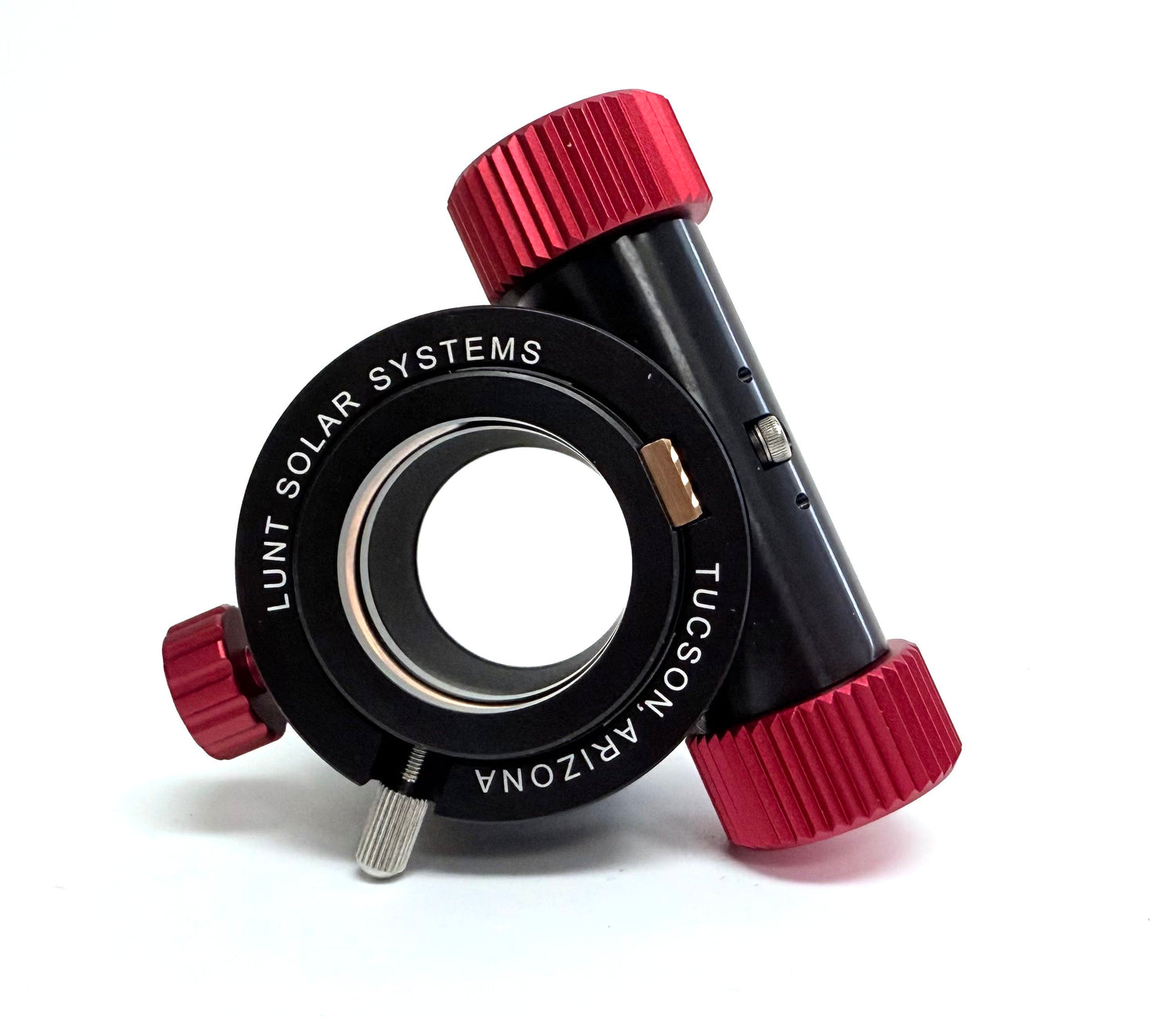


Significant Advantages of Lunt Design Approach vs Competition
Share
TECHNICAL MEMO: Pressure Tuning vs. Mechanical Compression
Etalon Tuning Methods in Hydrogen-Alpha Solar Telescopes
Overview
There are fundamentally two approaches to tuning an air-spaced etalon to the hydrogen-alpha wavelength (656.28nm):
1. Pressure Tuning — Changing the air pressure (and thus refractive index) inside a sealed cavity containing the etalon
2. Mechanical Compression — Physically compressing the etalon plates together to reduce the gap spacing
Lunt Solar Systems uses pressure tuning exclusively. Some competitors use mechanical compression, including designs derived from the original Coronado SM70 (circa 2000) and the later Coronado RichView system.
This memo outlines the technical differences and their practical implications.
A Note on Competition and Innovation
Let’s address the obvious: SkyWatcher’s new Heliostar system, at launch, outperformed the previous-generation Lunt etalon specification. That’s simply a fact — and it’s no more surprising than a new Android outperforming an older iPhone.
The “old” Lunt products were the gold standard for a very long time. You don’t mess with success until you have to. Perhaps it took a kick in the backside from a competitor to accelerate changes that were already in development.
But here’s what matters to Lunt customers:
We are raising the bar again.
The new Lunt etalon specification (≤0.35Å single stack, ~0.22Å double stack) represents a significant advancement over both our previous products AND the current competition. Our customers can be assured they are following an innovative company — not a fossil.
Seeing a competitor release a superior product may sting for a moment. But it should also provide confidence: Lunt responds. Lunt innovates. Lunt does not rest on heritage alone.
The technical discussion that follows explains why the underlying Lunt architecture — pressure tuning — remains fundamentally superior to mechanical compression, regardless of the etalon specification built on top of it.
1. ALTITUDE AND BAROMETRIC PRESSURE SENSITIVITY
The Problem with Mechanical Compression:
Air-spaced etalons rely on the refractive index of air in the gap to determine center wavelength (CWL). The refractive index of air changes with atmospheric pressure.
As stated in Lunt’s technical documentation:
“Slight changes in barometric pressure and/or a change in altitude will affect the CWL due to the change in refractive index of the spacer layer caused by the change in air pressure.”¹
For a mechanically-compressed etalon that is open to ambient atmosphere, observing at 10,000 feet will have a completely different tuning point compared to sea level. Weather changes (barometric pressure shifts) will also cause the CWL to drift during an observing session.
The Pressure Tuning Solution:
“Because the etalon is suspended in a sealed cavity it is 100% altitude insensitive.”¹
The Lunt system seals the etalon inside a pressure-controlled cavity. The pressure tuner changes the refractive index of air in the entire sealed cavity. External atmospheric conditions have no effect on the etalon’s center wavelength.
Reference: Lunt Solar Systems, “Viewing With Hydrogen Alpha Telescopes”¹
2. MECHANICAL STABILITY AND LONGEVITY
The Problem with Mechanical Compression:
Mechanical compression systems physically squeeze the etalon plates together. As documented in the Cloudy Nights forums:
“The PST uses compression tuning. The Teflon ring in the chamber is the main point of pressure. The silicone ring (the orange foam) is designed to smash the etalon until it comes into tune. Since it never compresses evenly the silicone ring is trimmed and cut so that it applies pressure as evenly as possible… It is not compressing the spacers at all, it is deforming the plates around the spacers.”²
This approach has several failure modes:
• “Setting” over time — Mechanical assemblies under constant pressure can take a permanent set, causing drift
• Differential compression — Uneven pressure across the etalon causes non-uniform CWL across the aperture
• Plate deformation — Pressure applied to optical surfaces can bend the plates, degrading parallelism
• Thermal expansion — Differential heat expansion between mechanical components causes tuning drift
As noted in a Cloudy Nights discussion:
“Most of the tuning issues from the PST arise from a poorly implemented mechanical pressure tuning, where the etalon not only is compressed as intended, but is also able to tilt in its cell.”³
The Coronado RichView system, used in later SM-series etalons, applies pressure via a central pad to compress the etalon gap. As documented by Christian Viladrich:
“CWL set by varying the air gap thickness. This is done by rotating the outside ring of the mount, which in turn applies a pressure on the center of the etalon (RichView mechanism).”⁴
The Pressure Tuning Solution:
“The Lunt etalon is not compressed by mechanical methods. Mechanical compression relies heavily on the ability to produce optically precise components that will not change over time.”¹
“The pressure tuner changes the refractive index of the air in the entire sealed cavity and applies no differential pressure to the etalon itself.”¹
The Lunt etalon plates experience no mechanical stress from the tuning mechanism. The etalon is mounted on small silicone pads inside the sealed chamber, isolated from mechanical forces.
3. TUNING PRECISION AND DOPPLER CAPABILITY
Mechanical Compression Limitations:
Mechanical systems have inherent backlash and hysteresis. The tuning mechanism must overcome static friction before the etalon responds, making precise positioning difficult.
Additionally, the tuning range is often limited. As noted by one observer:
“The tilt tuner of the Coronado just barely reaches the H-Alpha center wavelength at the very end of the tilting range… The current position of the H-Alpha center wavelength at the end of the tilting range prevents me from doing Doppler shift imaging where one image is taken in the red wing and one in the blue wing of H-Alpha.”⁵
Pressure Tuning Advantages:
“The air pressure system allows for immediate change to the center wavelength (CWL) without the use of electricity or heat.”¹
“Because the air pressure can be changed almost instantly with the PT knob, we can Doppler shift through the wings of the H-alpha line very quickly, providing for professional level observation and study of fast-moving events.”¹
The same observer comparing systems noted:
“The pressure tuning principle is much superior. I can tune from far red off-line into far blue off-line and hit the center spot precisely.”⁵
4. CALIBRATION CAPABILITY (Coming Soon)
Pressure tuning enables a capability that mechanical compression cannot match: factory calibration with a known pressure-to-wavelength curve.
Because the relationship between cavity pressure and center wavelength is predictable and repeatable, Lunt can characterize each etalon on the 1.5-meter scanning monochromator and provide a calibration curve showing exact wavelength as a function of pressure setting.
This allows users to: - Know precisely where on the H-alpha line they are observing - Reproducibly return to specific wavelength positions - Perform quantitative Doppler measurements
Mechanical compression systems cannot provide this capability because the relationship between compression force and wavelength is affected by mechanical hysteresis, temperature, and long-term drift.
Monochromator-calibrated pressure-tuned etalons are currently in development.
5. THE RIGID MOUNT PROBLEM: WHEN “STIFF” IS A DISADVANTAGE
The Paradox of Rigid Optical Mounting:
In precision optomechanics, the goal is NOT to make the mount as rigid as possible. The goal is to constrain the optic exactly as needed — no more, no less. When a manufacturer boasts that their etalon mounting system is “very stiff,” this is actually a warning sign, not a feature.
As stated in the University of Arizona’s optomechanical engineering curriculum:
“If a movement in any particular degree of freedom is prevented by more than one mechanism, then a body is overconstrained, and its support system becomes redundant. All but one of the constraints will be ineffective, or the body will be deformed by the multiple constraint, and loads will be indeterminate.”¹
A rigid body has exactly six degrees of freedom. A properly designed kinematic mount constrains exactly six — no more. Any additional constraint causes distortion.
The Fundamental Problem with Mechanical Compression:
When an etalon is held in a rigid, stiff mechanical system that applies compression for tuning, the optical element is now subject to all the mechanical imperfections of the mounting system:
• CTE mismatch — The coefficient of thermal expansion of aluminum (23.6 ppm/°C), steel (12 ppm/°C), and fused silica (0.55 ppm/°C) differ by orders of magnitude. Temperature changes cause differential expansion that stresses the optic.
• Manufacturing tolerances — Mechanical components are manufactured to tolerances of ±0.001” at best. Optical surfaces are polished to λ/50 (~12nm). The mechanical system has tolerances 2,000× worse than the optics it controls.
• Thermal gradients — A rigid mount transmits thermal gradients directly to the optical element, causing non-uniform stress distribution.
As the Sigmadyne optomechanical engineering team documents:
“Birefringence may be generated in optical elements from mechanical loads acting on the optical system during standard operation. Uniform temperature changes produce mechanical stress in optical components due to mismatches in coefficients of thermal expansion between cemented elements and/or mounting materials.”²
Stress-Induced Birefringence:
When mechanical stress is applied to optical glass, it changes the refractive index of the material — a phenomenon called stress birefringence. This is not theoretical; it is a well-documented failure mode in precision optics.
From the textbook Polarized Light and Optical Systems (Chipman, Lam, Young):
“Stress induced birefringence is a widespread and often unavoidable problem in optical systems which frequently occurs in injection molded plastic optics due to molding processes, and in glass lenses as a result of poor opto-mechanical mounting techniques.”³
The effect of stress birefringence:
“The effect of stress, whether mechanically-induced or residual, is to change the index of refraction of the optical material. The resulting state of birefringence creates wavefront error and polarization changes in light propagating through the optical system.”²
For an etalon — which depends on precisely controlled optical path length through the cavity — any change in refractive index from mechanical stress directly affects the center wavelength and uniformity.
Why Kinematic Mounting Matters:
The gold standard in precision optics is kinematic mounting, which Newport Optics describes:
“The advantages of a kinematic mount are: increased stability, distortion free optical mounting and, in the case of a kinematic base, removable and repeatable re-positioning.”⁴
The key phrase is “distortion free.” A kinematic mount achieves this by using exactly the constraints needed — no more.
From ScienceDirect:
“The kinematic mount assumes that the contact of the mount and the lens with 6-DOF occurs only at infinitesimal points, and any lens with more than six contact points is over-constrained.”⁵
The Lunt Approach:
Lunt etalons are mounted on small silicone pads inside the sealed pressure chamber. The etalon is not rigidly constrained. The tuning mechanism (air pressure) applies uniform force across the entire cavity without differential stress on the optical surfaces.
The mechanical tolerances of the pressure chamber do not affect the optical performance because there is no mechanical coupling between the chamber and the etalon’s optical surfaces.
In contrast, a “stiff” mechanical compression system creates a direct mechanical linkage between components manufactured to thousandths-of-an-inch tolerances and optical surfaces polished to nanometer precision. The optic becomes a slave to the limitations of the mechanical system.
References for Section 5:
1. University of Arizona OPTI521, “Tutorial on Kinematic Constraints,” wp.optics.arizona.edu/optomech/wp-content/uploads/sites/53/2016/10/FellowesTutorial1.pdf
2. Doyle, K.B., “Stress Birefringence Modeling for Lens Design and Photonics,” Sigmadyne, sigmadyne.com/sigweb/downloads/IODC-Birefringence.pdf
3. Chipman, R., Lam, W.T., Young, G., “Stress-Induced Birefringence,” Chapter 25, Polarized Light and Optical Systems, Taylor & Francis (2018)
4. Newport Corporation, “Optical Mirror Mount Technology Guide,” newport.com/n/optical-mirror-mount-technology-guide
5. ScienceDirect, “A strain-free semi-kinematic mount for ultra-precision optical systems,” doi.org/10.1016/j.optlaseng.2020.106274
6. THE TRIFID TUNER: CENTER COMPRESSION PHYSICS
What the Trifid System Does:
SkyWatcher’s mechanical compression system is called the “Trifid Tuner” (named for its similarity to the Triffid Nebula). As described by SkyWatcher:
“The Trifid Tuner applies physical pressure to the etalon plates allowing the observer to reach the desired Hydrogen emission line.”¹⁴
An independent review in Cloudy Nights describes the mechanism:
“The method used by SkyWatcher involves the use of mechanical pressure to tune the etalon by compression of the central etalon spacer.”¹⁵
The Non-Uniform Compression Problem:
When you push on the center of an etalon assembly while supporting it at the edge, you create a complex stress distribution:
1. Center compression: The center spacer (foot) compresses directly under load
2. Plate bending: The front plate flexes under the point load, creating a bowl shape
3. Edge differential: The peripheral spacers see reduced compression because the plate has bowed
4. Stiffness gradient: The edge of the plate assembly is significantly stiffer than the center
This means the etalon gap is NOT uniform across the aperture. The center compresses more than the edges, creating a non-parallel cavity. The result is:
• Variable center wavelength across the aperture (center vs. edge)
• Broadened effective bandpass
• Reduced contrast
• “Sweet spot” viewing where only part of the field is on-band
The Cloudy Nights review acknowledges this:
“Too high a CWL could lead to an excessive etalon gap variation with higher levels of center-only compression, which can result in a broadening of the etalon’s bandpass and decreased contrast levels.”¹⁵
Why Use Center Compression? — A Manufacturing Shortcut
Proper etalon manufacturing requires: 1. Polish plates extremely flat and parallel 2. Apply high-reflectivity coatings 3. Select spacers that match the coating spec to place CWL in the tuning range 4. Assemble with optical contact or precision bonding
Step 3 is expensive — you need to measure each coating run, calculate the required spacer thickness, and maintain tight inventory control.
By using aggressive mechanical compression, a manufacturer can skip this precision matching. They can assemble an etalon at ANY center wavelength and simply compress it through its Free Spectral Range (FSR) until it lands on H-alpha. The Trifid mechanism allows them to use whatever spacers are available and “tune it in” mechanically.
This is a production cost optimization, not a performance optimization.
Why Center Foot Design? — Compensating for Poor Flatness
The center foot (central spacer) design originates from early Coronado manufacturing. Its purpose is to allow plates that are NOT ideally flat to be pulled or pushed toward parallel.
If you have properly polished plates at λ/50 flatness, you don’t need a center foot — the plates will contact the peripheral spacers uniformly.
The center foot acts as an adjustment mechanism to compensate for: - Plates with residual curvature - Plates that are “high” or “low” in the center - Manufacturing variability in flatness
This is why Lunt does NOT use center foot designs. Our plates are polished flat enough that they don’t require mechanical correction.
Optical Contact Fatigue — The Long-Term Concern
In the new SkyWatcher design, the center foot is optically contacted to the etalon plates. This creates an additional concern: cyclic fatigue of the optical contact bond.
Every time the user adjusts the Trifid Tuner, they are: 1. Applying load to the center of the assembly 2. Causing the center area to flex 3. Creating cyclic stress at the optical contact interface
Optical contact bonds are designed for static applications. They rely on molecular adhesion (Van der Waals forces) between perfectly clean, flat surfaces. The bond strength is excellent under static load but degrades under cyclic stress.
As documented in materials science literature:
“Delamination is an insidious kind of failure as it develops inside of the material, without being visible on the surface, much like metal fatigue.”¹⁶
“After 1000 cycles, many cracks were found in the center of the bonding interface, which indicated that mechanical fatigue after thermal cycling was the main reason for the initial cracks.”¹⁷
The question is not IF the optical contact will eventually fail under cyclic loading — it is WHEN. How many tuning cycles can that center foot take before the contact begins to degrade? A hundred? A thousand?
When an optical contact fails on an etalon center foot, the result is catastrophic: the etalon gap becomes undefined, the center wavelength drifts or becomes unstable, and the entire system fails.
The Lunt Approach: Minimizing Coupling
The most ideal etalon support is no support at all.
Of course, this is impossible — you need to hold the etalon in place, and it must survive shipping. But the design goal should be to minimize coupling between the mechanical structure and the optical element.
Lunt has learned from over 20 years of experience that the support system must: 1. Withstand the gauntlet of shipping and handling 2. Remove any physical effects from the etalon during use 3. Remove any thermal effects from the etalon during use
Our solution: We “float” our etalons on small pads of silicone inside a sealed cavity. The silicone pads provide: - Vibration isolation during shipping - Thermal decoupling from the chamber walls - Zero mechanical stress during tuning (pressure changes affect only the air, not the pads) - No cyclic loading on any bond or contact
The etalon plates experience no differential stress. The tuning mechanism does not touch the optic. The chamber can expand and contract with temperature while the etalon floats freely.
The Bottom Line on Center Foot Failure:
Continuous cycling of mechanical pressure on an optically contacted center foot is not a question of IF it will fail — it is WHEN.
Every tuning adjustment applies stress to that contact. Every temperature cycle causes differential expansion. Every shipping event subjects it to vibration and shock loading. The optical contact was designed for static applications, not cyclic fatigue.
Users purchasing these systems today should understand that they are buying a consumable mechanism. At some point — perhaps after hundreds of cycles, perhaps after thousands — that center foot contact will begin to degrade. When it does, the etalon becomes unusable.
Lunt pressure-tuned etalons have no such failure mode. There is no stressed bond. There is no center foot. There is nothing to decontact.
7. HISTORICAL CONTEXT
The mechanical compression approach used in some current products is not new technology — it derives from designs that are over two decades old.
The Coronado SM70 (circa 2000) used mechanical compression for tuning. The later Coronado RichView system refined this approach but retained the fundamental mechanical compression architecture.
When Coronado was acquired by Meade and later by JOC, the RichView design continued in the SM-II and SM-III product lines before Coronado’s eventual decline.
Lunt Solar Systems was founded on the principle that pressure tuning offered a superior approach. The company developed manufacturing techniques to produce pressure-tuned systems at scale, and has refined this technology continuously over more than two decades.
The appearance of new products using mechanical compression represents a return to an older approach — not an advancement.
8. PROVEN TRACK RECORD
Lunt pressure-tuned systems have been in continuous production for over 20 years. They are used by:
• NASA (2024 Eclipse live broadcast)
• National Geographic (Easter Island documentary)
• U.S. Air Force
• Princeton University
• UCLA
• The Smithsonian
• Research institutions worldwide
This track record demonstrates both the reliability and longevity of the pressure tuning approach.
Summary Comparison
|
Characteristic |
Pressure Tuning (Lunt) |
Mechanical Compression |
|
Altitude sensitivity |
None (sealed cavity) |
Significant |
|
Barometric pressure sensitivity |
None |
Significant |
|
Mechanical stress on etalon |
None |
Continuous |
|
Coupling to mount tolerances |
None (air gap) |
Direct mechanical link |
|
Stress birefringence risk |
Minimal |
Significant |
|
Compression uniformity |
N/A (no compression) |
Non-uniform (center vs. edge) |
|
Center foot required |
No (plates polished flat) |
Yes (compensates for poor flatness) |
|
Cyclic fatigue on bonds |
None |
Every tuning adjustment |
|
Long-term drift |
Minimal |
Can “set” over time |
|
Tuning precision |
High (no backlash) |
Limited by mechanics |
|
Doppler range |
Full red-to-blue wing |
Often limited |
|
Calibration capability |
Yes (pressure vs. wavelength) |
Not practical |
|
Heritage |
20+ years in production |
Derived from ~25-year-old designs |
References
Sections 1-4:
1. Lunt Solar Systems, “Viewing With Hydrogen Alpha Telescopes,” luntsolarsystems.com/pages/viewing-with-hydrogen-alpha-telescopes
2. SolarChat Forum, “Coronado PST Etalon tuning anti-slip bearing modification,” solarchatforum.com/viewtopic.php?t=27491 (March 2020)
3. Cloudy Nights Forum, “A question about Coronado PST tuning,” cloudynights.com/topic/901041-a-question-about-coronado-pst-tuning/ (May 2025)
4. Christian Viladrich, “Coronado SM III 60 test,” astrosurf.com/viladrich/astro/instrument/spectro/SMIII-60/SMII-60.html
5. Tri-Valley Stargazers, “Lunt60PT and Coronado SolarMax60 comparison,” trivalleystargazers.org/gert/lunt_coronado/lunt_coronado_201306.html
6. Lunt Solar Systems, “A Simplified Explanation of Solar Telescopes,” luntsolarsystems.com/blogs/basic-how-tos/a-simplified-explanation-of-solar-telescopes
Section 5 — Optomechanical Engineering References:
7. University of Arizona OPTI521, “Tutorial on Kinematic Constraints,” wp.optics.arizona.edu/optomech/wp-content/uploads/sites/53/2016/10/FellowesTutorial1.pdf
8. Doyle, K.B., “Stress Birefringence Modeling for Lens Design and Photonics,” Sigmadyne LLC, sigmadyne.com/sigweb/downloads/IODC-Birefringence.pdf
9. Chipman, R., Lam, W.T., Young, G., “Stress-Induced Birefringence,” Chapter 25, Polarized Light and Optical Systems, Taylor & Francis (2018)
10. Newport Corporation, “Optical Mirror Mount Technology Guide,” newport.com/n/optical-mirror-mount-technology-guide
11. ScienceDirect, “A strain-free semi-kinematic mount for ultra-precision optical systems,” doi.org/10.1016/j.optlaseng.2020.106274
12. SPIE Digital Library, “Kinematic Mounts,” doi.org/10.1117/3.2317988.ch3
13. Rockwell International, “Kinematic mount for heavy optics,” US Patent 4,770,497 (1988)
Section 6 — Trifid Tuner / Center Compression References:
14. SkyWatcher USA, “Heliostar 76mm H-Alpha Solar Telescope,” skywatcherusa.com/products/heliostar-76mm-h-alpha-solar-telescope
15. Cloudy Nights, “Review of the SkyWatcher Heliostar 76 Hydrogen-Alpha Solar Telescope,” cloudynights.com/articles/user-reviews/review-of-the-skywatcher-heliostar-76-hydrogen-alpha-solar-telescope-r4791/ (October 2025)
16. Corrosionpedia, “Delamination,” corrosionpedia.com/definition/1371/delamination
17. PMC/MDPI, “Delamination of Plasticized Devices in Dynamic Service Environments,” pmc.ncbi.nlm.nih.gov/articles/PMC10972266/
Prepared by Lunt Solar Systems LLC, Tucson, Arizona April 2026