

Pressure Tuning a Solar Etalon: How Lunt Moves the Wavelength Without Mechanical Compression - Part 2
Share
In Part 1, I explained the basic physics of a Fabry-Perot etalon and the manufacturing process that goes into building one. This part covers something I consider one of the more elegant solutions in solar telescope design: how to tune an etalon in the field without touching the optical surfaces.
Tuning, in this context, means shifting the center wavelength of the etalon's transmission peak. You need to be able to do this because the hydrogen-alpha line you are observing is not always at the same apparent wavelength. Doppler shifting moves it depending on whether the solar feature you are watching is moving toward you or away from you. Atmospheric pressure and temperature changes affect it. And sometimes you simply want to move slightly off the line center to observe different structures. A fixed-wavelength etalon gives you one view. A tunable etalon gives you a whole spectrum of views across the line profile.
The Problem With Moving Parts
The straightforward way to tune an etalon is to change the cavity gap. If you make the gap slightly larger or smaller, the resonant wavelength shifts. The physics is simple. The mechanical execution is not.
The cavity gap in a solar etalon is on the order of 150 to 200 microns. The wavelength adjustment you need for practical solar observation is a fraction of an angstrom, which corresponds to a gap change of a few nanometers. You are talking about sub-nanometer mechanical control of a gap that is already microscopic. Any mechanism that achieves this while maintaining the parallelism of the two surfaces, without introducing stress, vibration, or hysteresis, is a serious engineering challenge.
Tilt tuning takes a different approach. Instead of changing the gap, you tilt the etalon relative to the incoming beam. As the angle of incidence changes, the effective path length through the cavity changes, which shifts the wavelength. This works, and some of my smaller instruments use it. The limitation is that tilting the etalon introduces a gradient across the field of view. The center of the field and the edges are seeing the etalon at slightly different angles, which means they are seeing slightly different wavelengths. For small apertures this is acceptable. For larger apertures it becomes a problem.
|
📷 IMAGE COMING SOON Diagram comparing tilt tuning vs. pressure tuning approaches. Show why tilt creates a gradient across the field, and why pressure affects the whole aperture uniformly. Clean educational graphic. |
What Pressure Tuning Does
The approach I use for most of my instruments is to leave the optical surfaces completely stationary and instead change the refractive index of the air inside the sealed cavity.
The resonant wavelength of a Fabry-Perot etalon depends on the optical path length between the surfaces, which is the physical gap multiplied by the refractive index of whatever fills that gap. In an air-spaced etalon, that medium is air. The refractive index of air changes with pressure. At higher pressure, air is slightly denser and has a slightly higher refractive index. This shifts the optical path length without changing the physical gap by a single nanometer.
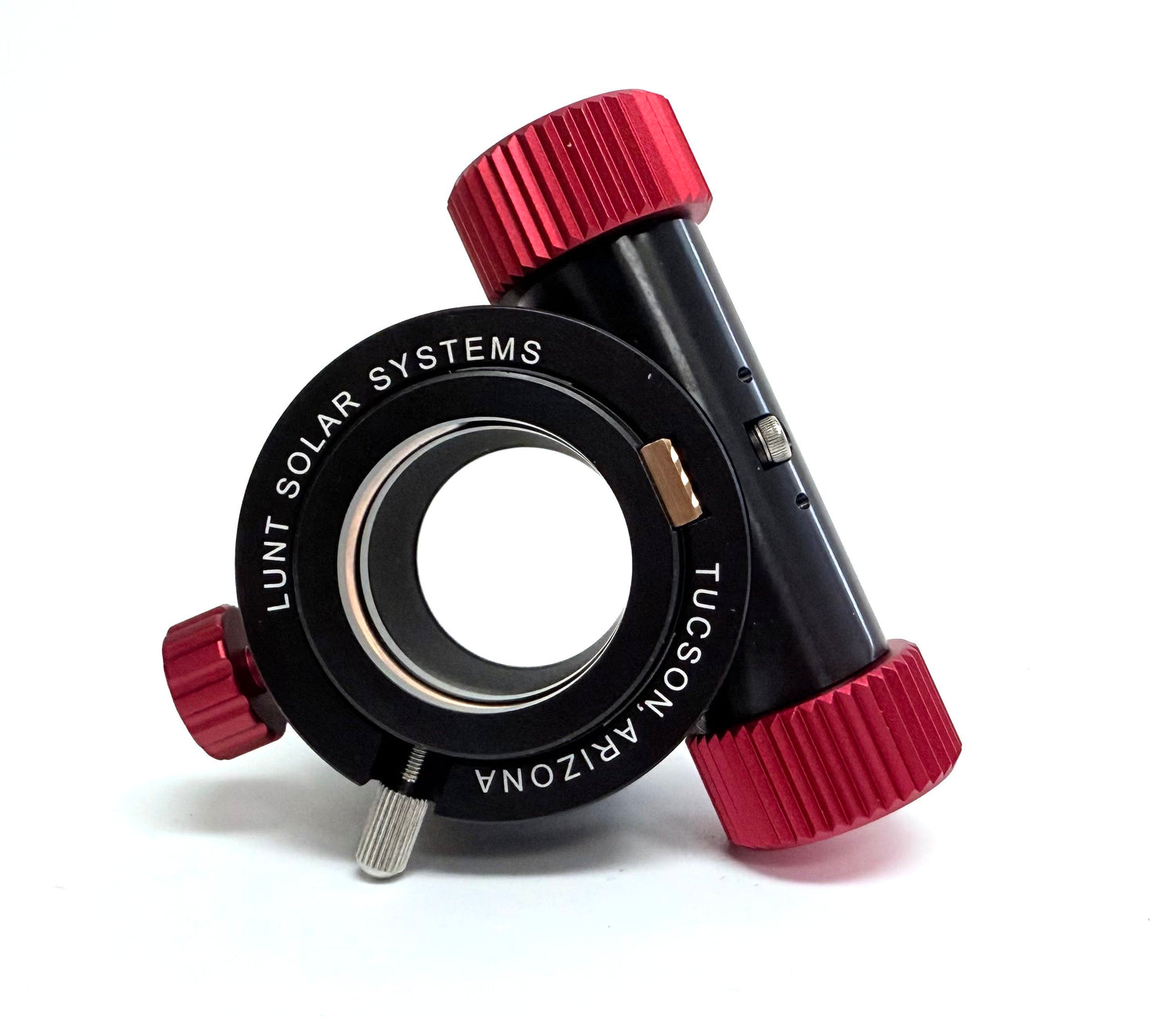
The practical implementation is straightforward in concept. The etalon assembly sits inside a hermetically sealed chamber. A small pneumatic control on the outside of the scope changes the pressure inside the chamber. As pressure increases, the effective optical path length increases, and the center wavelength shifts toward the red. Back off the pressure and it shifts back. The optical surfaces never move. There is no mechanism applying stress to the plates. The effect is uniform across the entire aperture because pressure acts equally everywhere.
Speed and Repeatability
One of the practical advantages of pressure tuning that observers notice immediately is the speed of response. Changing the air pressure in a small sealed chamber takes seconds. You turn the knob and the wavelength moves. This matters during solar observation because conditions change fast. A flare brightens and fades in minutes. A prominence erupts and you want to track it across the line profile while it is happening. A tuning mechanism that requires you to wait for thermal equilibrium or fiddle with a micrometer screw is a real limitation on what you can capture.
Repeatability is the other advantage. Pressure is easy to measure and control accurately. The wavelength shift is predictable and linear across the operating range. Observers who use my pressure-tuned instruments regularly develop an intuitive feel for the relationship between pressure setting and wavelength position. Some features are best viewed at line center. Others are better slightly off-band. Being able to move between those positions quickly and reliably changes what you can do with the scope.
|
📷 IMAGE COMING SOON Close-up of the pressure tuner control on a Lunt telescope. Show the knob and sealed chamber clearly. Well-lit product shot. |
The Sealed Chamber
The sealing system deserves some discussion because it is where the engineering either works or it does not. The chamber has to maintain a pressure differential reliably over the life of the instrument. It has to do this through temperature cycling as the scope warms up and cools down during a session. And it has to do it without contaminating the internal optical surfaces.
The seals in my pressure tuning system are precision O-ring designs selected for their resistance to compression set over time. Compression set is what happens when a rubber seal takes a permanent deformation under sustained compression and loses its ability to seal effectively. Dry climates accelerate this process. Most of my customers are in climates that are anything but humid, so seal longevity was a real engineering consideration.
When the seals do eventually wear, replacement is straightforward. Lunt sells O-ring service kits and the replacement procedure is something most owners can handle themselves. The chamber design allows access without disturbing the optical alignment.
Pressure Tuning Compared to Heated Solid Etalons
There is one alternative tuning approach worth comparing directly, because it represents a fundamentally different philosophy. Some etalon designs use a solid spacer material between the plates rather than an air gap. The spacer material expands slightly when heated, which changes the cavity gap and therefore the wavelength. To tune this type of etalon, you heat it.
The practical consequences of that approach are significant. Reaching thermal equilibrium takes time. The time varies depending on ambient temperature. In cold conditions it can take substantially longer than in warm conditions, which means your effective observing time shrinks in cooler weather. The tuning is also not rapid. Thermal inertia means the wavelength moves slowly and overshoots are possible. And the whole system is sensitive to changes in ambient temperature during a session, which can require ongoing compensation.
The solid spacer materials used in these designs also have their own optical properties. Mica, which is one material that has been used, has birefringence and potential internal imperfections that an air gap simply does not have. Air is a nearly perfect optical medium at the wavelengths and pressures involved in solar observation.
My pressure-tuned systems are ready to observe in the time it takes to point the scope at the sun. The wavelength is where you set it and stays there. That is not an accident of design. It is a deliberate choice about what matters to the person actually using the instrument in the field.
|
📷 IMAGE COMING SOON Side-by-side comparison image or graphic: pressure-tuned Lunt scope vs. heated solid etalon concept. Keep it factual and illustrative, not a direct competitor attack. |
A Note on Where This Technology Is Going
Etalon manufacturing is not a static field. The relationship between coating reflectivity, cavity geometry, and spectral performance is one I have been working through for my entire career, and I do not consider the current design the final word. The physics of what produces better solar views continues to inform how I build these instruments. I will have more to say on that in future articles.
If this raised questions I did not answer, I want to hear them. Post your question in the comments below or send it to us directly. I will collect the questions that come in and use them as the basis for a follow-up article in a few months. There are no bad questions when it comes to understanding how these instruments work.