

How to Choose a Solar Telescope: The Complete Buyer’s Guide
Everything you need to understand about hydrogen-alpha telescope technology, from etalon design to aperture selection — by someone who builds them.

Solar Telescopes Are Not Like Nighttime Telescopes
If you are coming from nighttime astronomy, you are used to a simple rule: bigger aperture means better views. More light-gathering power, more resolution, more detail. For deep-sky objects, that rule is mostly true.
Solar telescopes work differently. The Sun provides more light than you could ever need — the challenge is not collecting light, but filtering it. A solar telescope’s performance is determined primarily by the quality and design of its etalon filter system, not its aperture alone. A superbly made 80mm solar telescope will consistently outperform a mediocre 150mm system, because the etalon is doing the real work.
This guide explains what actually matters when choosing a hydrogen-alpha solar telescope. I have been designing and manufacturing etalons and solar instruments for over 25 years, and my goal here is to give you the same technical framework I use when evaluating any solar telescope — including my own.
The Etalon: The Heart of Every Solar Telescope
An etalon is an interference filter made from two extremely flat, extremely parallel glass plates with specialized high-reflectivity coatings on their inner faces. Light enters the cavity between the plates and bounces back and forth. At specific wavelengths — determined by the gap between the plates and the refractive index of the medium inside — the reflected waves constructively interfere, and light passes through. At all other wavelengths, the light is reflected away.
For hydrogen-alpha observation, the etalon is tuned to transmit a narrow band centered on 656.28 nanometers — the wavelength emitted by hydrogen atoms in the Sun’s chromosphere. How narrow that band is, and how cleanly the etalon rejects everything else, determines what you see through the eyepiece.
The specifications that matter
Bandpass (FWHM) is the width of the transmission peak measured at half its maximum intensity. A single-stack etalon typically delivers 0.5 to 0.7 angstroms. A double-stacked system narrows this to approximately 0.35 to 0.5 angstroms. Narrower bandpass means higher contrast on surface features like filaments and plage, because you are rejecting more of the bright photospheric background.
Free Spectral Range (FSR) is the spacing between adjacent transmission peaks. An etalon does not transmit at just one wavelength — it produces a “comb” of peaks across the spectrum. The FSR must be wide enough (typically greater than 10 angstroms) so that the secondary blocking filters can completely suppress the unwanted peaks. If the FSR is too narrow, stray light leaks through and washes out contrast. FSR is a function of the gap between the plates: narrower gap means wider FSR.
Peak transmission is the percentage of light at the target wavelength that passes through the etalon. This is determined largely by the reflectivity of the coatings. Higher reflectivity coatings produce narrower bandpass but also lower peak transmission — less light gets through. This is a deliberate engineering trade-off. For solar observation, the Sun provides enormous amounts of light, so sacrificing some transmission for tighter bandpass is almost always the right decision. A solar telescope does not need to be bright; it needs to be contrasty.
Optical surface quality of the etalon plates is arguably the most critical factor, yet the one least discussed. If the plates are not flat and parallel to extreme precision — we polish ours to better than λ/50 transmitted wavefront — the bandpass broadens, uniformity degrades, and contrast suffers. No amount of high reflectivity or clever tuning can compensate for poor surface quality. This is where manufacturing experience and metrology capability make the difference.

How Solar Telescopes Are Tuned: Pressure vs. Tilt vs. Thermal
The etalon needs to be precisely centered on the hydrogen-alpha wavelength, and that center point can shift with temperature, altitude, and the specific feature you want to observe. Different manufacturers use different mechanisms to tune the etalon. This is one of the most consequential design decisions in a solar telescope.
Pressure tuning (Lunt’s approach)
In a pressure-tuned system, the etalon sits inside a hermetically sealed chamber. Adjusting the air pressure inside the chamber changes the refractive index of the air between the plates, which shifts the transmission wavelength. This is a smooth, continuous, and extremely precise adjustment.
Pressure tuning has several technical advantages. The wavelength shift is instantaneous — there is no warm-up time or thermal equilibrium to wait for. The pressure change affects the entire etalon aperture uniformly, maintaining consistent bandpass across the full field of view. The sealed chamber isolates the system from altitude changes, so the telescope performs identically whether you are at sea level or on a mountaintop. And because pressure tuning does not rely on heating, there is no power consumption and no environmental sensitivity.
Most importantly for solar observation, pressure tuning enables true Doppler tuning. By shifting the center wavelength slightly to the blue or red side of H-alpha, you can observe material moving toward or away from you on the Sun’s surface. This creates a three-dimensional view of filaments and active regions — you can tune from base to tip and see structure that is invisible at a fixed wavelength. This is a capability unique to pressure-tuned systems.
Tilt tuning
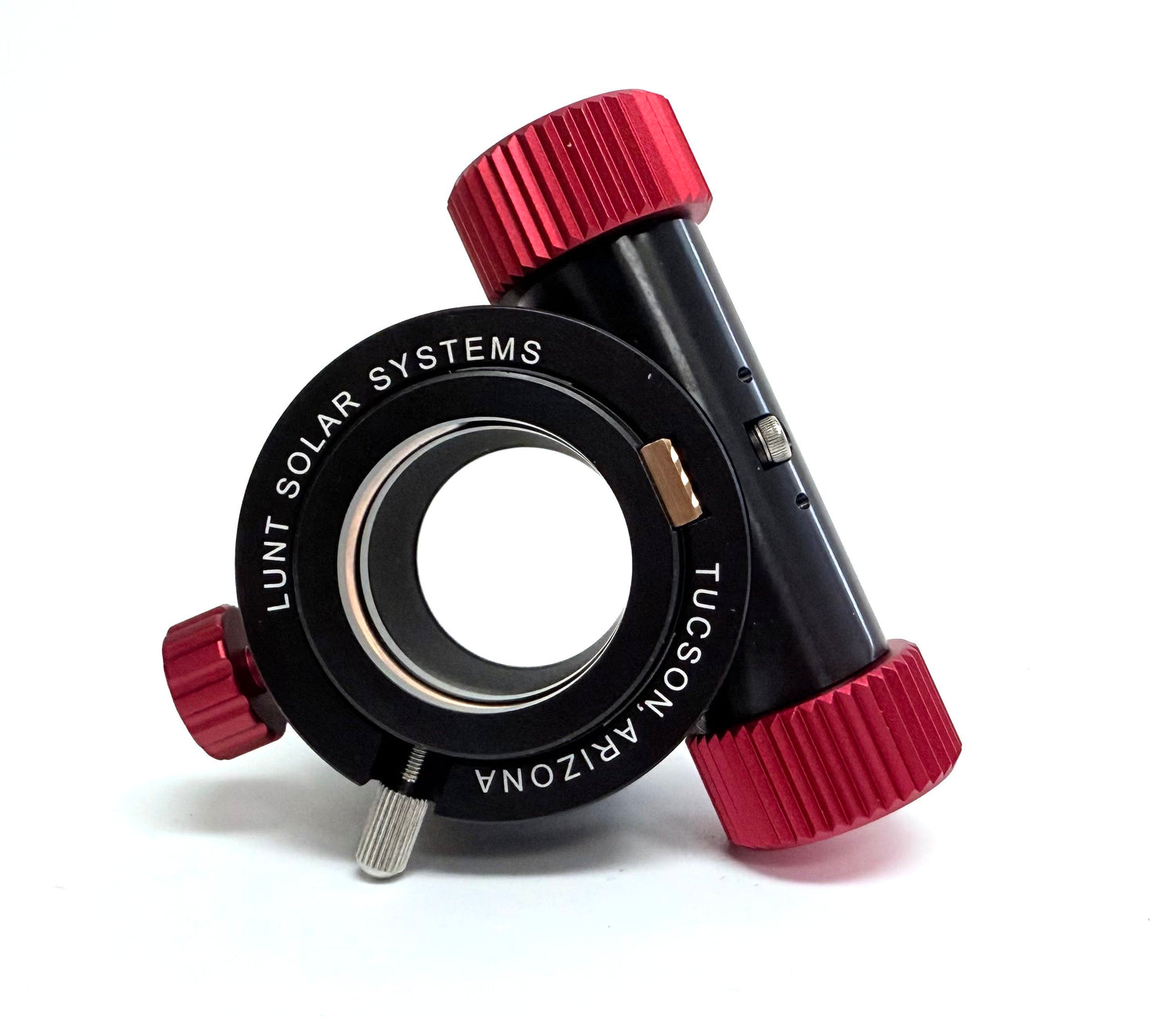
Tilt tuning mechanically angles the etalon plates relative to the incoming light beam. Changing the angle of incidence shifts the effective optical path length, which shifts the transmission wavelength. This approach is simple and reliable, and Lunt uses it in some entry-level products like the LS40THa.
The trade-off is that tilting the etalon introduces a slight asymmetry across the field — one side of the image may be slightly more on-band than the other. This is usually minor and acceptable for visual observation, but pressure tuning delivers more uniform performance across the full aperture.
Thermal tuning (mica-spaced etalons)
Some competitors use solid etalons with mica spacers bonded between the plates with optical wax. Tuning is achieved by heating the assembly, which expands the mica and shifts the wavelength. This approach has several limitations that buyers should understand.
Thermal tuning requires 10 to 30 minutes of warm-up time before the system reaches equilibrium and can be used. It consumes significant power (10–50 watts). Performance varies with ambient temperature — particularly problematic for daytime observing when the environment is already warm. Mica is a naturally occurring mineral with inherent optical imperfections including internal stria and crystalline defects. And the optical wax deteriorates over time with thermal cycling, eventually requiring factory service.
Thermal tuning also cannot provide the continuous, real-time Doppler scanning that pressure tuning offers. By the time you have thermally shifted the wavelength, the solar feature you were observing may have evolved.
Aperture: What Size Do You Actually Need?
Aperture matters in a solar telescope, but not for the reasons nighttime astronomers expect. You are not gathering light — you are resolving detail. Larger aperture provides higher theoretical resolution, a bigger solar image at the focal plane, and the ability to see finer features like spicules and chromospheric fibrils.
However, atmospheric seeing sets a hard ceiling on usable resolution, and daytime seeing is generally worse than nighttime. On a typical day, atmospheric turbulence limits effective resolution to what a 100–130mm aperture can deliver. On exceptional days, larger apertures shine. On poor seeing days, a smaller telescope may produce steadier, more satisfying views.
The practical advice: buy the largest aperture you can afford. A larger telescope can always be stopped down (Lunt’s Universal Telescopes include iris diaphragms for exactly this purpose), but a smaller telescope cannot be made larger. You are buying capability for your best seeing days, not your average ones.
What each aperture delivers
|
Aperture |
Solar Image |
Resolves |
Best For |
|
40–50mm |
~4–5mm |
Prominences, filaments, plage, active regions |
Portable grab-and-go, first solar telescope, travel |
|
60mm |
~5.5mm |
Above + finer filament detail, chromospheric texture |
Versatile day/night use, solid imaging platform |
|
80mm |
~7mm |
Above + spicules, fibrils, fine active region structure |
Serious visual and imaging, best balance of size and performance |
|
100mm |
~9mm |
Above + granulation detail, subtle plage structure |
Advanced observers and imagers, research-grade capability |
|
130mm |
~11mm |
Near-maximum ground-based resolution |
Observatory-class, demanding seeing conditions |
|
152mm |
~13mm |
Maximum detail on exceptional seeing days |
Dedicated solar observatory, professional imaging |
Double-Stacking: The Biggest Visual Upgrade
If aperture determines how much detail you can resolve, double-stacking determines how well you can see that detail. Adding a second etalon in series narrows the combined bandpass and, more importantly, dramatically reduces out-of-band light leakage. The visual effect is striking: the background photosphere darkens, surface features jump into sharper relief, and filaments that were barely visible in single-stack become obvious.
The math is straightforward. When two etalons with identical bandpass are combined, the resulting bandpass is approximately the original divided by the square root of two. Two 0.65Å etalons produce a combined bandpass of roughly 0.46Å. But the real improvement happens in the wings of the transmission curve — the out-of-band rejection improves far more than the FWHM number suggests, which is where the contrast gain comes from.
Many experienced observers consider double-stacking the single most significant upgrade they have made. Lunt’s modular system design allows you to add double-stack capability at any time. The Premium tier of every Solar Ready Bundle includes double-stack from the start.
Front-mounted vs. internal double-stack
A front-mounted double-stack etalon sits ahead of the telescope objective, filtering the light before it enters the optical path. This produces the highest uniformity and contrast because the etalon operates on a fully collimated beam. An internal double-stack etalon sits inside the telescope, after the collimating optics. It is smaller, less expensive, and easier to add as an upgrade, with slightly less uniformity.
Both approaches work well. If you already own a front-mounted Lunt etalon filter system (like the LS40F or LS50F) and later purchase a dedicated Lunt telescope, your front filter becomes a double-stack filter — protecting your original investment.
Safety Architecture: What to Look For
Solar telescope safety is non-negotiable, and not all approaches are equal. A properly designed system uses multiple independent filtering stages so that if any single element fails, the observer is still protected. This is called redundant safety architecture.
Every Lunt telescope incorporates at least five independent filtering stages: an energy rejection filter at the front of the system that blocks UV and IR before it enters the telescope; the etalon itself, whose high-reflectivity coatings reject the vast majority of incident light; a Schott BG glass filter for additional IR absorption; a wavelength-selective filter in the diagonal; and the blocking filter at the eyepiece end that eliminates any remaining out-of-band transmission.
This multi-layer approach was reviewed and approved by a senior ophthalmology professor at a leading Canadian university. The safety criterion requires less than 1×10⁻⁵ transmission of any hazardous radiation. Several individual filters in a Lunt system meet this criterion on their own — the full system exceeds it by orders of magnitude.
When evaluating any solar telescope, ask: how many independent safety stages does the system provide? What happens if the blocking filter is accidentally removed? What happens at non-H-alpha wavelengths? If the manufacturer cannot answer these questions clearly, that should give you pause.
Questions to Ask Before You Buy Any Solar Telescope
Whether you are evaluating Lunt or any other manufacturer, these are the questions that separate well-engineered systems from compromises:
What is the etalon’s optical surface quality? If the manufacturer does not publish this or cannot tell you, it is likely not exceptional. Lunt publishes interferometric data from our Zygo Verifire — we show our work.
Is the bandpass specification measured or theoretical? Theoretical bandpass assumes perfect optics. Real-world bandpass depends on surface quality, parallelism, and coating uniformity. Ask for measured data.
How is the etalon tuned? Pressure tuning offers instantaneous response, uniform performance, altitude independence, and Doppler capability. Thermal tuning requires warm-up time and deteriorates with age. Tilt tuning is simple but introduces field asymmetry.
How many independent safety stages does the system have? More is better. Ask what happens if the blocking filter is removed.
Is the system modular? Can you add double-stack capability later? Can you upgrade the blocking filter for imaging? Modular design protects your investment.
Where is it made and who supports it? When something needs adjustment or service — and eventually it will — who do you call? Lunt builds, tests, and supports everything from our facility in Tucson.

Matching a Telescope to Your Goals
With all of that technical context, here is practical guidance for choosing the right Lunt system. We have organized our product line into Solar Ready Bundles — complete packages at three tiers — to make this decision simpler.
First solar telescope / casual observer
Start with an LS40THa or LS50THa Standard Kit ($895–$995). These are dedicated hydrogen-alpha telescopes with everything included to begin observing immediately. The LS50THa includes pressure tuning with Doppler True capability. Compact, portable, and an outstanding introduction to solar astronomy.
Versatile day-and-night use
The 60mm or 80mm Universal Telescope in Enhanced or Premium configuration ($1,795–$3,495). These modular systems convert from H-alpha solar to nighttime deep-sky use in minutes. The 80mm with its FPL53 doublet and tighter <0.60Å bandpass is particularly impressive for the price.
Serious solar observing and imaging
The LS80MT or LS100MT Premium Kit ($3,495–$4,995) with double-stack from day one. At 80–100mm with sub-0.5Å bandpass, you have a research-grade system capable of resolving the finest solar detail visible from the ground on good seeing days.
Observatory installation
The LS152THa is our largest dedicated system, delivering observatory-class performance at 152mm aperture with <0.60Å bandpass. For maximum resolution on exceptional seeing days, nothing in the commercial market surpasses it.
Already own a refractor? The LS40F and LS50F front-mounted etalon systems convert your existing telescope into an H-alpha instrument, and later become double-stack filters when you upgrade to a dedicated Lunt scope.
The Best Solar Telescope Is the One You Use
Solar observation rewards consistency. The Sun changes every day — every hour. Major flares, prominence eruptions, and filament formations happen without advance notice, and the only way to witness them is to be at the eyepiece when they occur.
With Solar Cycle 25 still producing exceptional activity and the August 12, 2026 European total solar eclipse approaching, there has never been a better time to invest in a solar telescope. The best system for you is the one that fits your budget, matches your goals, and gets used regularly.
Browse the complete Solar Ready Bundle lineup or read our Solar Observation Guide to learn what you will see through an H-alpha telescope. And if you have questions, call us at 520-344-7348. We build these instruments by hand, and we are always happy to talk solar.