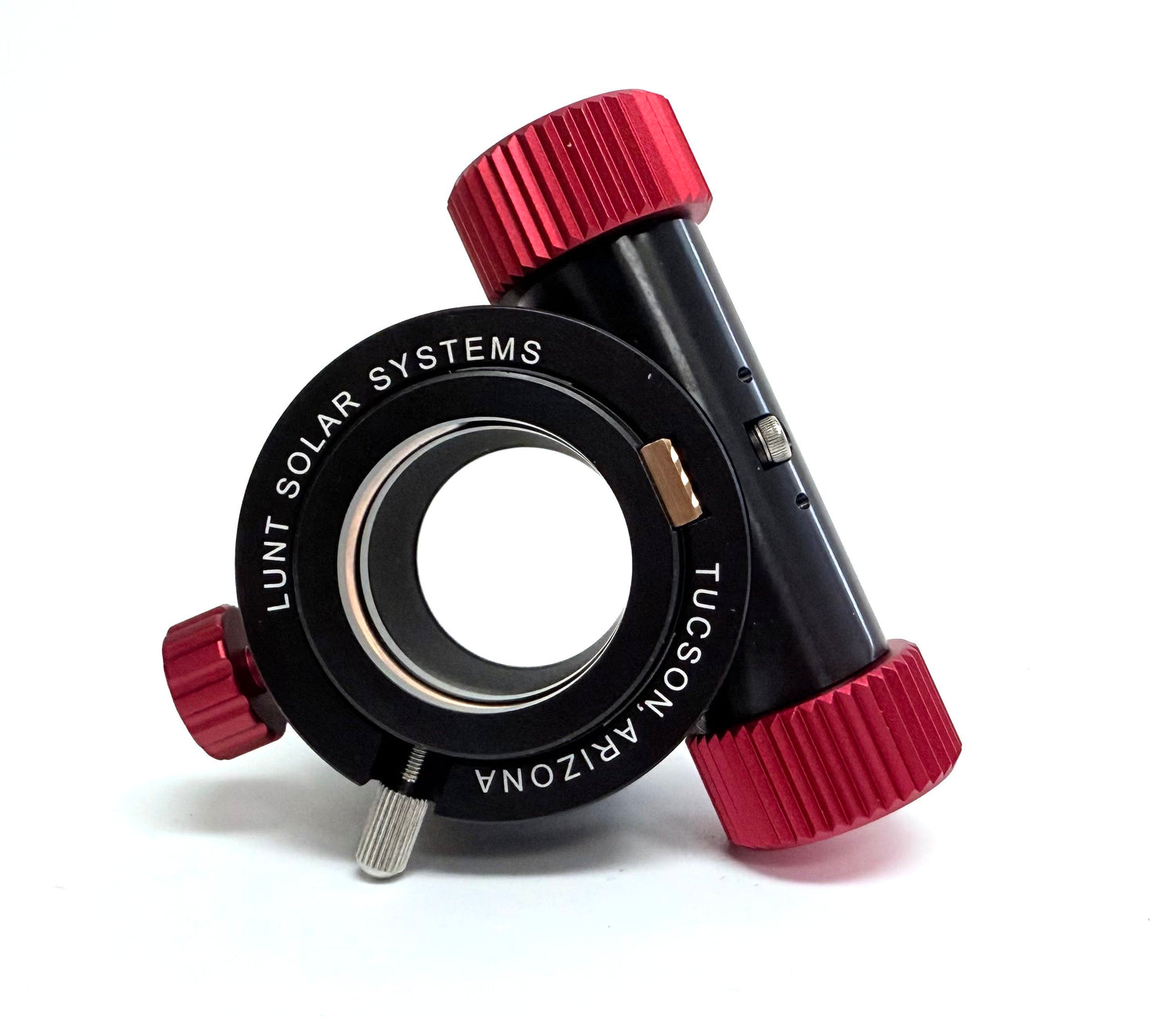


How a Lunt Solar Telescope Keeps Your Eye Safe
Share
A plain explanation of the layered filtration inside a dedicated hydrogen-alpha solar telescope: what each element does, why the design relies on redundancy rather than any single component, and how to inspect your instrument before every session. Written for the curious owner who wants to understand the engineering before putting an eye to the eyepiece.
Why we wrote this
Looking at the Sun is the one thing every astronomer is told never to do. A dedicated solar telescope exists to do exactly that, safely, by removing almost all of the Sun's energy before it ever reaches your eye and passing only a razor-thin sliver of light at the wavelength where the Sun's surface activity reveals itself. That is a serious engineering responsibility, and our customers are right to ask how it works.
Many of the people who buy our instruments come from technical backgrounds. They work in optics, in physics, in engineering. They want to understand the safety architecture, not simply be told to trust it. We think that is exactly the right instinct. An owner who understands why the instrument is safe is a safer owner, because they know what to check, what to protect, and what a problem would look like if one ever appeared.
This article explains, in general terms that apply across our product line, how solar filtration works, why the design is built around overlapping and redundant protection, and how you can inspect your own telescope before each observing session. We have been building solar telescopes for two decades, and the people behind this company were doing this work at Coronado before that. The explanation below reflects that experience.
The core idea: energy removed, not merely dimmed
Sunlight is not one thing. It arrives as a broad spectrum, from ultraviolet through visible light and out into the infrared. The visible glare is the part you notice, but it is the invisible ultraviolet and infrared energy that poses much of the risk, precisely because you cannot see it and your eye gives you no warning that it is there. Any device that claims to make solar viewing safe has to deal with the whole spectrum, not just the brightness your eye can perceive.
This is the single most important idea in the whole subject, so we will state it plainly. Safe solar viewing is about removing harmful energy across the ultraviolet, visible, and infrared bands, not simply dimming the visible brightness until it looks comfortable. A filter can make the Sun look pleasantly dim while still transmitting dangerous invisible energy. Comfort is not safety. This is why a solar telescope's design cannot be judged by how the image looks, and why a brighter view is not evidence of a better instrument. In fact, brightness that seems too good can be a warning sign, because it may mean energy is getting through that should have been rejected.
The filter stack, element by element
A dedicated hydrogen-alpha solar telescope does its job through a series of optical elements working together. The exact arrangement and the exact parts vary between models, but the roles are consistent across the range. Here is what each type of element contributes to the whole. We describe them generically on purpose, because the safety comes from the system as a whole rather than from any single part in any single position.
The energy rejection filter
At or near the front of the instrument sits an element whose job is to reject the great bulk of the Sun's incoming energy before it travels any further into the telescope. It sharply reduces both the heat, meaning the infrared, and the ultraviolet, sending most of the Sun's power away before it can build up inside the optical path. Think of this as the first and largest reduction, the element that turns a firehose into something the rest of the system can manage.
The etalon
The etalon is the heart of a hydrogen-alpha telescope and the reason the Sun looks the way it does through one. It is a precision interference filter that isolates an extraordinarily narrow slice of the spectrum centered on the hydrogen-alpha line, the specific red wavelength where solar prominences, filaments, and surface texture become visible. The etalon's role is defining what you see. Everything else in the stack is there to make sure that what reaches your eye at every other wavelength has been reduced to a safe level.
The colored-glass and absorption filters
Within the stack are one or more colored-glass filters, elements of specialized optical glass chosen for how they absorb particular bands of the spectrum. Some are selected for their behavior in the infrared, others for the way they clean up unwanted parts of the visible and near-visible range. These are workhorses. They quietly absorb energy in the bands where they are strong, adding their attenuation to everything the elements ahead of and behind them are already doing.
The reflective and blocking elements
Further along the path, additional elements continue the job. A diagonal or mirror element folds the light path to a comfortable viewing angle and, in doing so, contributes its own selectivity about what it passes and what it does not. A dedicated blocking filter near the eyepiece provides a further stage of attenuation, tightening the final result at the point closest to your eye. By the time light reaches the eyepiece, it has passed through this entire sequence, and each stage has taken its share.
Why redundancy is the whole point
Notice what all of these elements have in common. They do not divide the spectrum up so that each one guards a separate territory with no overlap. They overlap. More than one element attenuates the ultraviolet. More than one attenuates the infrared. The reductions stack on top of each other, and because attenuation multiplies as light passes through successive elements, the combined effect is far deeper than any single element provides on its own.
This overlap is not an accident of the design. It is the design. It means the instrument's safety does not hang on the perfect condition of any one part. That is the answer to the question thoughtful owners often ask, which is some version of: what happens if one filter degrades? The system is built so that the harmful bands are attenuated by more than one element, with substantial margin beyond what is needed. A single element falling short of its best does not open a clear window to your eye, because other elements are attenuating the same band at the same time. Depth of protection through redundancy is exactly how safety-critical engineering is supposed to work, and it is how these instruments are built.
We verify the cumulative effect of the complete stack, and we build to a level of attenuation that carries meaningful margin across the harmful spectrum. We deliberately do not publish a single headline number as a specification. We will explain why in a moment, because it connects to something worth understanding about this entire product category.
A word about specifications and standards
Customers sometimes ask which safety standard a solar telescope meets, and they expect a tidy answer, a number or a certification code they can check off. The honest answer is more interesting than that, and worth understanding.
There is a well-known standard for solar viewing, ISO 12312-2. It is a genuine and valuable standard, but its scope is specific: it governs afocal filters for direct naked-eye viewing, meaning eclipse glasses and handheld solar viewers. Those are simple products. A flat filter, held in front of the unaided eye, doing one job. The standard was written for that, and for that it works well.
A telescope is a different kind of problem entirely. It gathers and concentrates light, it magnifies, and it protects the eye through a sequence of interacting optical elements rather than a single flat filter. The eyewear standard was never written for magnifying optical instruments and does not extend to them. This is not a loophole or an omission. It is simply that the two products are different in kind, and a standard built for one does not describe the other.
This has a practical consequence that we want our customers to understand clearly. A safety figure borrowed from the eclipse-glasses standard is a specification for a piece of eyewear, not for a telescope. Applying an eyewear number to a telescope, or presenting a telescope as conforming to the eyewear standard, means attaching a credential to a product the credential was never designed to describe. We choose not to do that. We describe what our instruments actually do, harmful ultraviolet and infrared radiation reduced to safe levels through redundant, verified filtration, and we let that honest description stand on its own rather than borrowing the language of a standard that does not apply.
There is no regulatory body that certifies solar telescopes, and precisely because there is no governing standard for the product, we are careful not to invent a rigid numeric specification and present it as though an authority had blessed it. What we offer instead is transparency about the engineering, two decades of doing this work, and a design philosophy built on margin and redundancy. We would rather earn your trust with an honest explanation than with a number lifted from the wrong document.
Inspecting your telescope before every session
Because the instrument protects you through its physical elements, keeping those elements in good condition is part of safe operation. None of this is difficult, and it becomes second nature quickly. Before each observing session, take a moment to check the following.
• Inspect every optical surface you can see for cracks, chips, delamination, or any change in appearance. A filter surface should look clean and intact. If any element shows a crack, a chip, or a cloudy or hazy patch that was not there before, stop and contact us before observing.
• Confirm that all elements are seated and secure, with nothing loose, rattling, or able to shift position. The stack protects you only when every element is where it belongs, in the order it belongs.
• Check that the blocking filter and diagonal assembly near the eyepiece are firmly attached and undamaged. This is the last stage before your eye and deserves particular attention.
• Look for any obvious contamination, moisture, or fogging inside the optical path. Ordinary dust on an outer surface is cosmetic and normal. A sudden change, internal moisture, or a hazy film is worth asking us about before you proceed.
• Begin every session by looking at the projected or low-magnification view first, and never assume. If anything about the brightness or the image looks unusual or unexpectedly intense, stop and investigate before putting your eye to the eyepiece.
The guiding principle is simple: if anything looks wrong, do not observe until you have checked with us. We would always rather answer a question about a hazy filter than have an owner press on in doubt. There is no such thing as a question too small when your eyesight is involved.
Cleaning, maintenance, and when to ask
Owners with a technical bent are often tempted to open things up, clean internal surfaces, and investigate for themselves. We understand the impulse completely. But the optical elements in a solar telescope are precision components, some of them coated, some of them aligned to tolerances that matter, and the safest rule is to be conservative about what you disturb.
Cleaning an accessible external lens surface with proper technique is reasonable. Disassembling the instrument to reach internal elements is not something we recommend doing on your own, because it risks contamination, misalignment, or damage to elements that are part of the safety stack. If you see something inside the optical path that concerns you, the right move is to send us clear photographs and let us advise. Often what looks alarming is harmless, and in the rare case that it is not, we would much rather handle it as service than have a valued element disturbed.
If your instrument arrived with something that seems loose, or if you notice debris or marks on an internal surface, contact us with your serial number and photographs before taking anything apart. We keep records, we know these instruments intimately, and we can tell you quickly whether what you are seeing is normal or something we should look at.
The bottom line
A dedicated solar telescope is safe because it removes the Sun's harmful energy across the whole spectrum, not because it dims the view until it looks comfortable. It does this through a sequence of overlapping filter elements, each contributing its share, engineered so that protection is deep, redundant, and carries margin to spare. It does not depend on any single component being perfect, and it does not depend on a certification borrowed from a standard written for a different kind of product.
We build these instruments to be trusted with the one thing no one can replace, and we would rather explain honestly how they work than ask you to take our word for it. If you have read this far and still have questions about your specific instrument, that is exactly the kind of owner we hope to have. Write to us. We will answer.
Lunt Solar Systems has been designing and manufacturing dedicated solar telescopes for over twenty years. Questions about your instrument, its safety, or its care are always welcome. Contact us with your model and serial number and we will be glad to help.