

Doppler True — What Full-Range Tuning Actually Means for Solar Observation
Share
The previous posts in this series have focused on what goes wrong with mechanical compression tuning — non-uniform gap, bandpass broadening, optical contact fatigue, altitude sensitivity. This post is different. It is about what goes right with pressure tuning — and specifically about a capability that pressure tuning enables and that compression systems can only partially approximate.
That capability is full-range Doppler tuning. And understanding what it actually means requires starting with the physics of the hydrogen-alpha line itself.
The Hydrogen-Alpha Line Is Not a Point
When most observers think about tuning a solar etalon, they think about it in binary terms: either you are on-band or you are not. Either the etalon is centred at 656.28nm and you see the chromosphere, or it is shifted off that wavelength and the view degrades.
This is not wrong, but it is incomplete. The hydrogen-alpha spectral line is not an infinitely narrow point in the spectrum. It has a finite width — a profile that extends on either side of the central wavelength, with the emission intensity decreasing as you move away from line centre. And the structure of that profile encodes something remarkable: the velocity of the plasma that emitted it.
The physics is the Doppler effect. When a hydrogen atom in the chromosphere is moving toward you, the light it emits is shifted slightly toward shorter wavelengths — blue-shifted. When it is moving away, the light is red-shifted. The faster the motion, the greater the shift. Solar plasma moves at extraordinary velocities. Violent explosions in the Sun's chromosphere can cause solar plasma to move at enormous speeds, shifting the H-alpha emission through the Doppler effect. Sky-Watcher USA Spicules — the jets of plasma that create the "furry" appearance of the solar limb — move at velocities of 20-50 kilometres per second. Solar flare ejecta can exceed 1,000 kilometres per second. At H-alpha wavelengths, these velocities produce measurable wavelength shifts — shifts that place the emission from moving plasma in the wings of the line rather than at line centre.
This means that the hydrogen-alpha line is not simply a switch you are either on or off. It is a three-dimensional landscape of plasma velocity. Different parts of the line profile show you different things — different structures moving at different speeds in different directions relative to your line of sight.
What You See at Different Points in the Line
At line centre — 656.28nm — you see the chromosphere in its most complete form. Filaments, plage, the chromospheric network, quiet sun structure, prominences at the limb. This is the view most solar observers are familiar with.
In the red wing of the line — shifted toward longer wavelengths — you see plasma falling toward the solar surface. Downflowing material in active regions, the descending phase of oscillating chromospheric features, the return flow in prominence loops. Features moving away from you are red-shifted into this part of the profile.
In the blue wing — shifted toward shorter wavelengths — you see plasma rising, moving toward you. Erupting material, the ascending phase of chromospheric oscillations, the early stages of prominence eruptions and flare ejecta. Fast-moving material approaching the observer appears here, often brilliantly bright against features that are invisible at line centre.
Doppler tuning reveals motion in high-velocity solar plasma, letting you highlight structures moving toward or away from the observer and adding depth and dynamism to filaments, prominences, and active regions. David Astro An eruptive event that appears as a subtle brightening at line centre can appear as a dramatic high-velocity ejection in the blue wing. A prominence that seems stable at line centre may show internal flow patterns — material rising on one side and falling on the other — when you scan through the line.
The chromosphere in Doppler-tuned light is not just two-dimensional. It has depth. You are looking at three-dimensional plasma dynamics, resolved by velocity.
What Full-Range Tuning Requires
To access this full observational capability, you need to be able to move your etalon's centre wavelength smoothly and precisely through the full width of the hydrogen-alpha line — from the red wing, through line centre, to the blue wing and back — on demand, instantly, without drift and without requiring physical readjustment of the instrument.
This places specific demands on the tuning system:
The range must be sufficient. The hydrogen-alpha line extends significantly on either side of line centre when you account for the velocity range of solar plasma. A tuning system whose range is limited — either by the physics of the mechanism or by operational constraints — cannot access the full wing structure where the most energetic events appear.
The response must be immediate. Solar eruptive events develop on timescales of seconds to minutes. A flare ejecta that is visible in the blue wing right now may be gone or substantially changed in five minutes. A tuning system with slow response, significant hysteresis, or mechanical backlash cannot track these events effectively.
The tuning must be precise and repeatable. To compare features at specific wavelength offsets from line centre — to understand the velocity structure of a specific active region — you need to be able to return to specific tuning positions accurately. A system with backlash or positional uncertainty cannot provide this capability reliably.
The system must be stable. A tuning point that drifts with temperature, barometric pressure, or altitude is not a useful reference for Doppler observations. The observer needs to know that when they have set the tuning to a specific position, it stays there.
What Pressure Tuning Delivers
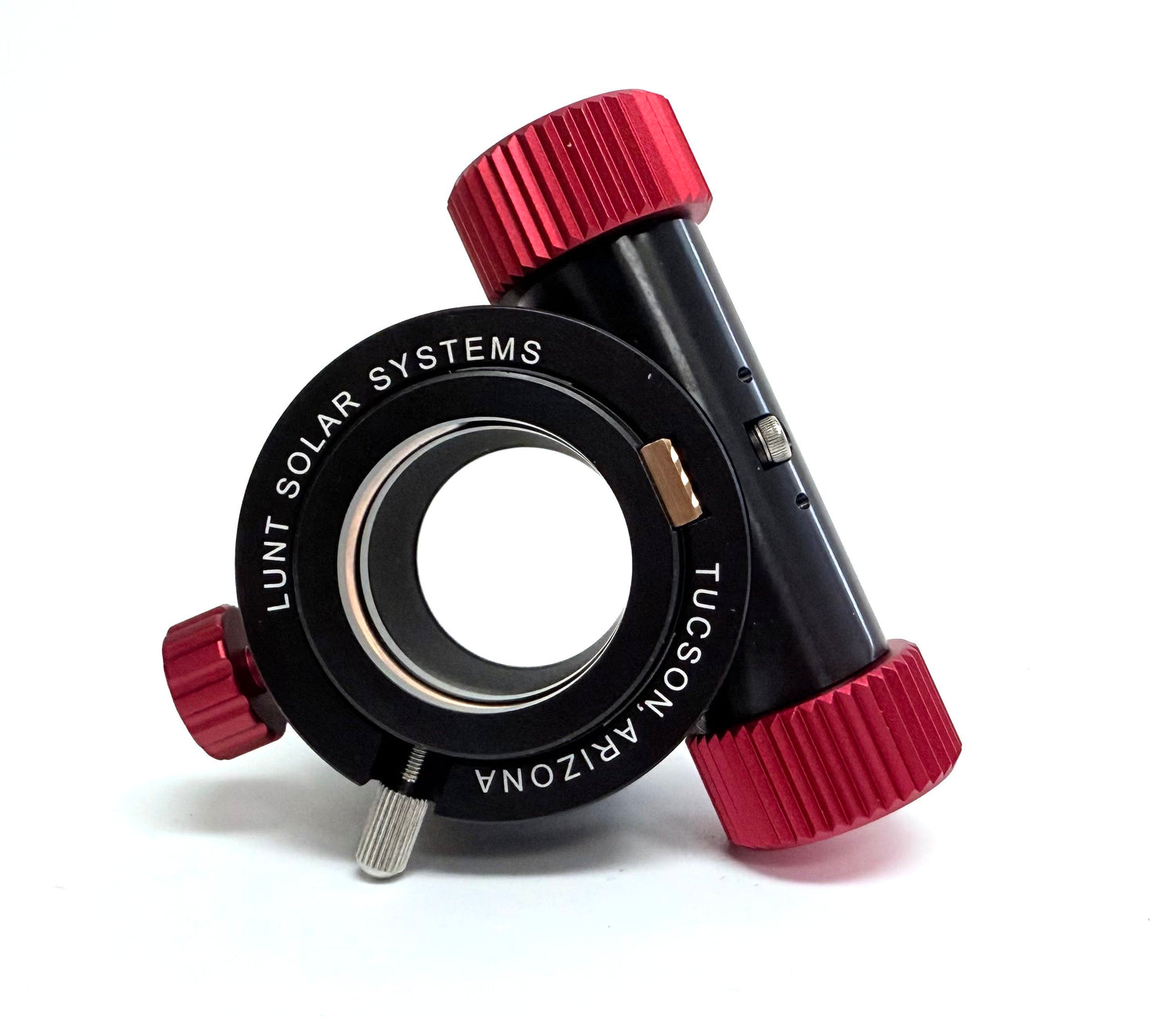
The Lunt Doppler True Barometric Pressure Tuning system satisfies all of these requirements directly from the physics of the mechanism.
The tuning range is determined by the pressure range available in the sealed cavity — which is designed to cover the full hydrogen-alpha line from red wing to blue wing without restriction. At ambient pressure the centre wavelength sits in the red wing. As pressure increases the centre wavelength moves through line centre and into the blue wing. The full Doppler range of solar plasma is accessible without approaching any mechanical limit.
The response is immediate. Changing cavity pressure with the tuning knob produces an instant change in the refractive index of the air throughout the sealed cavity and an immediate shift in centre wavelength. There is no mechanical component moving between contact surfaces, no static friction to overcome, no backlash. The response is as fast as you can turn the knob.
The tuning is precise and repeatable. Because the relationship between cavity pressure and centre wavelength follows predictable physics — the refractive index of air as a function of pressure is well characterised — specific tuning positions are reproducible. Turn to the same knob position and you return to the same wavelength. Lunt's precision metrology equipment allows us to characterise each etalon's pressure-to-wavelength curve, providing a calibration reference that no mechanical compression system can offer.
The tuning is stable. The sealed cavity isolates the etalon from ambient conditions entirely. Barometric pressure changes, temperature variations, and altitude changes have no effect on the internal cavity pressure unless the observer changes it. A tuning point set at the start of an observing session stays at that tuning point throughout the session, regardless of what the weather does.
One independent observer who compared pressure tuning to alternative systems summarised the practical experience precisely: "The pressure tuning principle is much superior. I can tune from far red off-line into far blue off-line and hit the centre spot precisely."¹
What Compression Tuning Delivers — and Where It Falls Short
A mechanical compression system can tune through the hydrogen-alpha line — that is its stated purpose and it achieves it to varying degrees. But the characteristics of compression tuning create practical limitations that become apparent when full Doppler capability is the goal.
The tuning range in a compression system is determined by the mechanical travel of the compression mechanism. At one end, minimum compression — the etalon at its natural gap spacing. At the other end, maximum compression — the mechanical limit of the mechanism. The usable range within this travel that actually covers the hydrogen-alpha line depends on where the as-manufactured CWL happened to land, as discussed in Post 1. An etalon that requires significant compression just to reach line centre has less compression range available for blue-wing tuning than one that lands closer to H-alpha naturally.
This means the accessible Doppler range is not a fixed property of the design — it varies across the production run, determined by the same manufacturing CWL lottery that determines fatigue life. An observer who wants to observe blue-wing ejecta at high velocity may or may not have sufficient tuning range available, depending on where their specific unit landed in the manufacturing window.
The response characteristics of mechanical compression also differ from pressure tuning. Mechanical systems have inherent static friction — the compression mechanism must overcome a threshold force before it begins to move. This creates a small dead zone around any tuning position where small knob adjustments produce no response. Combined with mechanical backlash — the small amount of free play in any mechanical linkage — this means that fine, precise positioning of the centre wavelength requires skill and experience to achieve reliably.
As the sky-Watcher Heliostar's own documentation notes, tuning the Trifid requires a "back-and-forth" adjustment process to home in on the desired wavelength.² This is the practical expression of mechanical hysteresis. The observer learns to work with it. But it is a fundamentally different experience from a pressure-tuned system where the knob position directly and immediately determines the centre wavelength.
Doppler Tuning at the Eclipse
The August 2026 total solar eclipse offers an observational opportunity that goes far beyond white-light totality. In hydrogen-alpha light, and with full Doppler tuning capability, the eclipse presents a once-in-a-generation view of chromospheric plasma dynamics in a context where the geometry of totality reveals structures normally hidden in solar glare.
Prominences visible at the limb during totality are not static structures — they are dynamic plasma systems with internal flow patterns, oscillations, and in some cases active eruption. Doppler tuning during totality allows an observer to separate prominence plasma moving toward them from plasma moving away, revealing three-dimensional flow structure in features that appear one-dimensional in white light photography.
Chromospheric flash — the brief moment at second and third contact where the chromosphere is visible as a thin crescent around the lunar limb — shows H-alpha emission from the full chromospheric height range simultaneously. Doppler tuning during the flash can reveal velocity structure in the chromospheric layers that is otherwise accessible only to professional spectroscopic instruments.
For any of this to be possible, the tuning system must respond immediately and maintain its setting reliably throughout the event. Totality at most eclipse sites in 2026 lasts between approximately one and two minutes — the maximum anywhere along the path is 2 minutes and 18 seconds, just off the western coast of Iceland, and most locations in Spain will see totality of under two minutes. At some sites near the path edges, totality is measured in seconds. There is no time for warm-up, for backlash compensation, for drift correction. The instrument must be ready, stable, and fully responsive from the moment the diamond ring fades.
A pressure-tuned Lunt telescope is ready instantly. The sealed cavity is already at its operating condition from the moment you begin observing. The tuning knob responds immediately. The tuning point stays exactly where you set it. There is nothing to warm up, nothing to compensate for, nothing drifting.
The Name "Doppler True"
The Doppler True designation on Lunt telescopes is not marketing language — it is a technical description of what the pressure tuning system delivers. The tuning is true in the sense that it provides genuine, full-range, precise, stable, immediate control over the position of the etalon bandpass within the hydrogen-alpha line. Not a limited range that depends on manufacturing luck. Not a slow mechanical response that requires learned technique. Not a position that drifts with ambient conditions.
True Doppler tuning. Across the full line. From any location. At any altitude. Instantly, precisely, repeatably, for the life of the instrument.
That is what pressure tuning delivers. And it is why, when you are watching a solar eruption unfold and you want to follow the blue-shifted ejecta as they accelerate away from the surface, or the red-shifted downflow as material returns along magnetic loops, or the full velocity sweep of a developing flare — you want a Doppler True instrument in your hands.
¹ Independent observer comparison of pressure tuning versus alternative systems, Cloudy Nights forum ² Sky-Watcher Heliostar observer documentation describing Trifid tuning adjustment process ³ Wikipedia, "Hydrogen-alpha," en.wikipedia.org ⁴ Prairie Astronomy Club, "Observing the Sun in H-Alpha," prairieastronomyclub.org ⁵ DayStar Filters, Quark Chromosphere product documentation, davidastro.com
Next in this series: "Why 25 Years of Pressure Tuning Matters — Lunt, Coronado, and the Architecture That Changed Solar Astronomy"
About the Author
Andy Lunt is the founder of Lunt Solar Systems and the inventor of the pressure-tuned solar etalon system that defines the modern dedicated solar telescope. Before founding Lunt Solar Systems, Andy was the lead engineer at Coronado Instruments — the company founded by his father, David Lunt — where he designed most of Coronado's product line and worked directly on the internal etalon architectures described in this series. After Coronado's sale to Meade Instruments following his father's passing, Andy founded Lunt Solar Systems and invented pressure tuning as the solution to the etalon design problems he had lived through firsthand. He holds the original patent on pressure-tuned solar etalon systems and has over 25 years of experience in Fabry-Pérot etalon design and manufacture.