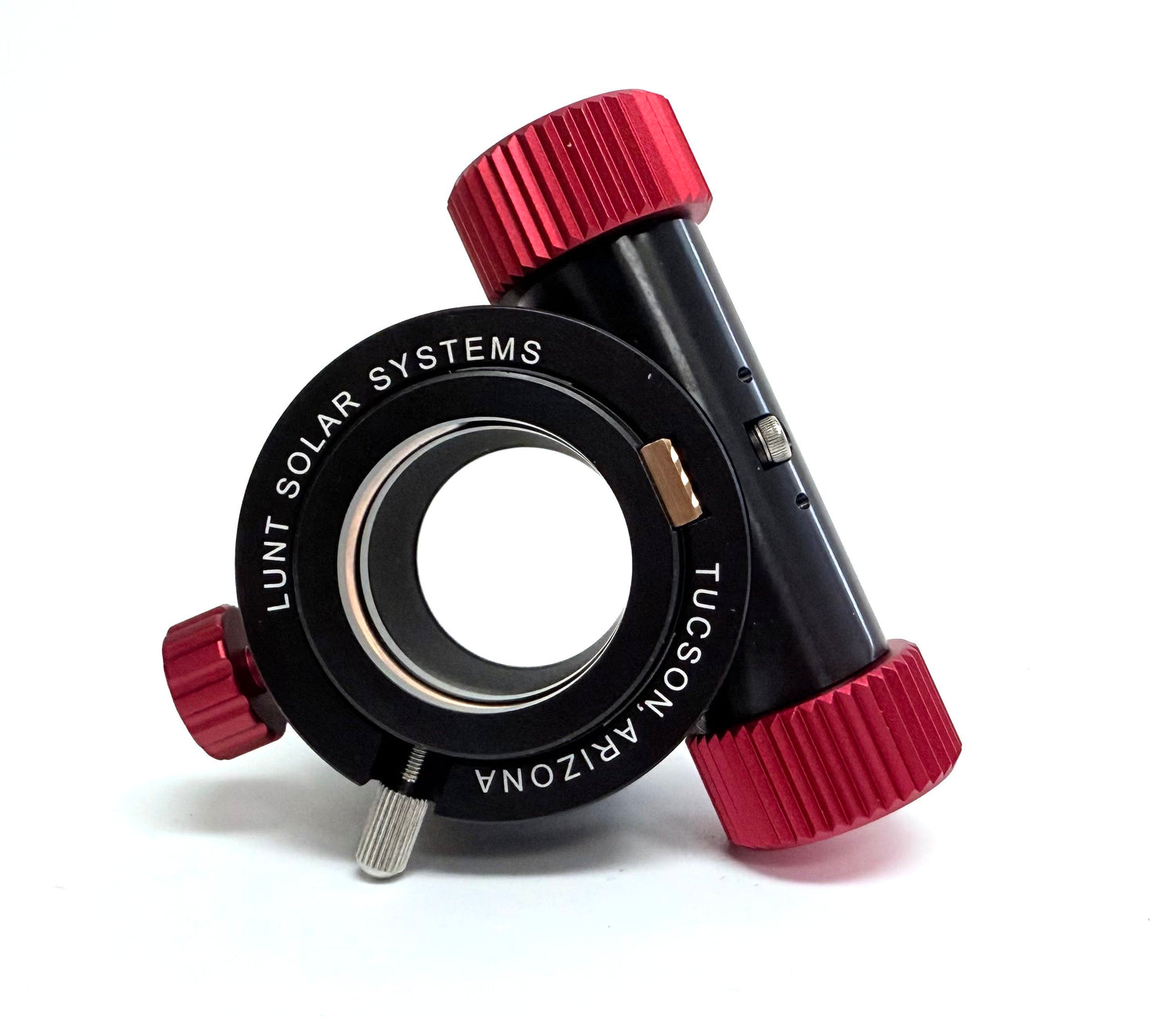


Altitude, Barometric Pressure, and Why Your Solar Telescope Shouldn't Care
Share
Solar observers are not homebodies. They travel — to dark sky sites, to eclipse paths, to mountain observatories with better seeing, to international star parties. The August 2026 total solar eclipse crosses Spain, Iceland, and Greenland. Serious observers planning for that event will be setting up equipment at locations ranging from sea-level coastal sites in northern Spain to high-altitude positions in the Pyrenees or on Icelandic plateaus.
If your solar telescope's tuning depends on ambient atmospheric pressure, every one of those locations presents a different problem. Your instrument that was perfectly tuned in your backyard arrives at a different altitude and is now off-band. The barometric pressure changes overnight as a weather front moves through — and your centre wavelength drifts with it.
This is not a hypothetical concern. It is a direct consequence of the physics of air-spaced etalons, and it affects different telescope designs very differently.
The Physics: Why Air Pressure Matters to an Etalon
An air-spaced etalon works by establishing a resonance condition between two parallel reflective surfaces separated by a precisely controlled gap. The wavelength transmitted depends on the optical path length through that gap — and optical path length is the physical gap distance multiplied by the refractive index of the material in the gap.
For an air-spaced etalon, the material in the gap is air. And the refractive index of air is not constant — it changes with pressure. At sea level, the refractive index of air is approximately 1.00028. At altitude, as atmospheric pressure decreases, the refractive index decreases toward its vacuum value of exactly 1.00000. As documented in Lunt's technical literature on hydrogen-alpha observation, this shift is substantial: the change in refractive index across the full range from sea level to vacuum represents a centre wavelength shift large relative to the 0.45Å bandpass of a single-stack Lunt etalon.¹
In practical terms: an etalon calibrated to H-alpha at sea level will be measurably off-band at altitude if the cavity air pressure tracks ambient atmospheric pressure. The refractive index of the gap air decreases, the optical path length shortens, and the centre wavelength shifts. Your telescope that worked perfectly at home needs retuning at the star party — and needs retuning again if a weather system moves through during the session.
The effect is not dramatic at modest altitude changes — it is not as though your telescope goes completely blind climbing a 2,000-foot hill. But at the narrow bandwidths involved in quality solar observation, measurable shifts in centre wavelength are visible as reduced contrast and suboptimal tuning. The observer compensates by retuning, but only if they know to look for it, and only if their instrument has sufficient tuning range to compensate. An observer who doesn't understand the physics may mistake the drift for deteriorating seeing conditions or a problem with the telescope itself.
The Open-Cavity Problem
A mechanical compression system that is not sealed against ambient atmosphere has its etalon cavity in equilibrium with the surrounding air. As ambient pressure changes — whether from altitude change or from a passing weather front — the refractive index of the air in the gap changes with it. The centre wavelength drifts.
This means that an observer taking an unsealed compression-tuned telescope to an eclipse at altitude faces a set of problems that are entirely absent from the telescope's behaviour at home. They need to retune upon arrival at altitude. They need to understand that barometric changes from a mountain weather system will shift their tuning during a session. And they need to recognise that the instrument behaves differently at different locations — not because anything is wrong with the telescope, but because the physics of an open cavity is inherently sensitive to the atmosphere it is open to.
Independent reviewers of the Sky-Watcher Heliostar noted that the telescope benefits from a warm-up period before observation — with one reviewer recommending waiting at least thirty minutes before imaging, as early unevenness in the view was observed to resolve with time.² Temperature equilibration is a real effect in compression-tuned systems, where thermal changes affect both the mechanical components and the air in the etalon cavity simultaneously. An observer in a changing environment — wind, cloud cover, temperature swings at altitude — is managing a tuning point that is genuinely in motion.
The Sealed Cavity Solution
Lunt Solar Systems addressed this problem by design, not as an afterthought. As stated in Lunt's technical documentation on hydrogen-alpha observation: "Because the etalon is suspended in a sealed cavity it is 100% altitude insensitive. The pressure tuner changes the refractive index of the air in the entire sealed cavity and applies no differential pressure to the etalon itself."³
The sealed cavity isolates the etalon from ambient atmospheric conditions entirely. The air inside the cavity is not in contact with the outside atmosphere. Ambient pressure changes — whether from altitude or from weather — have no effect on the air inside the sealed cavity, and therefore no effect on the refractive index of the gap air, and therefore no effect on the centre wavelength.
You can drive from Tucson to a 9,000-foot mountain site with a Lunt telescope in the back seat, set up at altitude, and observe without retuning for altitude. You can set up on a coastal site in northern Spain for the 2026 eclipse and then move to an Icelandic plateau the following week without adjusting anything fundamental about the instrument's behaviour. The physics inside the sealed cavity is identical regardless of where on Earth you are observing from.
The Pressure Tuner as Precision Control
The Doppler True pressure tuning system does more than isolate the etalon from ambient conditions — it converts what would be a liability in an open system into a precision control mechanism.
Because the relationship between cavity pressure and centre wavelength is predictable and repeatable, the pressure tuner gives the observer direct, precise control over exactly where on the H-alpha line they are observing. At ambient pressure the centre wavelength sits toward the red wing of the hydrogen line. As pressure increases the centre wavelength moves toward line centre at 656.28nm — the peak of the hydrogen-alpha emission. Pressurised further, the centre wavelength moves to the blue wing.³
This is Doppler tuning — the ability to deliberately scan through the hydrogen-alpha line to observe plasma moving at different velocities relative to the observer. Plasma moving toward the observer is blue-shifted; plasma moving away is red-shifted. By scanning through the line with the pressure knob, the observer can isolate and study these velocity components in real time. Fast-moving eruptive events, prominence dynamics, and the early signatures of solar flares all become accessible in a way that a fixed or limited-range tuning system cannot provide.
One independent observer who compared pressure tuning directly to tilt-tuned systems summarised it clearly: "The pressure tuning principle is much superior. I can tune from far red off-line into far blue off-line and hit the centre spot precisely."⁴ This is the practical expression of what the physics delivers — complete, precise, repeatable control over the full hydrogen-alpha line, from any location, at any altitude, in any weather.
In an open-cavity system, the observer is partially at the mercy of ambient conditions for their base tuning point. In a sealed pressure-tuned system, the observer is in complete control — ambient conditions are irrelevant, and the pressure knob provides precise, repeatable, immediate tuning capability across the full hydrogen-alpha line.
Thermal Sensitivity: A Related Problem
Altitude and barometric pressure are not the only ambient conditions that affect etalon tuning. Temperature matters too — both because it affects the density and refractive index of air, and because it causes thermal expansion and contraction in the mechanical components of the etalon assembly.
In a mechanically compressed etalon, temperature changes affect the compression mechanism and the etalon plates differently. Aluminium, steel, and fused silica have very different coefficients of thermal expansion — aluminium expands at 23.6 parts per million per degree Celsius, steel at 12 ppm/°C, and fused silica at just 0.55 ppm/°C. A temperature change that causes the aluminium housing to expand significantly causes the fused silica etalon plates to expand almost not at all. The resulting differential expansion changes the mechanical load on the etalon — and therefore changes the tuning. A compression-tuned system that is in tune at 20°C may be noticeably off at 30°C or 10°C.
This is consistent with what independent observers have documented. The warm-up period recommended for the Sky-Watcher Heliostar — at least thirty minutes of thermal equilibration before serious observation or imaging — is a direct consequence of thermal sensitivity in the compression and housing components.² In field conditions, where temperatures can swing significantly between setup and peak observing time, this is a real operational constraint.
The Lunt sealed cavity design is not immune to thermal effects — no instrument is — but the silicone isolation pads on which the etalon floats provide thermal decoupling between the etalon plates and the chamber walls. Temperature changes affect the chamber, but their effect on the etalon itself is substantially reduced. The pressure tuner compensates for any residual thermal shift with a simple knob adjustment, without the warm-up dependency that thermal coupling to mechanical compression components creates.
For the Eclipse Observer
The August 2026 eclipse is the reference event for European solar astronomy. Observers are travelling from across the world to positions along the path — sea-level coastal Spain, the mountains of the Pyrenees, the volcanic plateaus of Iceland, the ice sheets of Greenland. The altitude range across those sites spans from zero to several thousand feet. The weather variability — particularly in Iceland — is extreme. Temperature swings between night setup and daytime totality can be substantial.
An instrument whose tuning is sensitive to all of those variables is an instrument that requires active management throughout the event. An instrument whose sealed cavity isolates it from all of those variables is an instrument you can trust to behave the same way at totality that it did in your backyard three weeks before.
For an event where the window of totality is measured in minutes and seconds, and where conditions may be changing rapidly right up to the moment of contact, that reliability is not a luxury. It is a fundamental operational requirement.
Summary
Air-spaced etalons are sensitive to the refractive index of the air in their cavity — and that refractive index changes with ambient pressure and temperature. An etalon open to the atmosphere will drift in tuning with altitude, weather, and temperature. A sealed pressure-tuned cavity is isolated from all of these effects. The observer controls the tuning precisely with the pressure knob, independent of ambient conditions, from any location, at any altitude. The Doppler True system converts this isolation into positive capability — precise, repeatable, full-range tuning across the hydrogen-alpha line, on demand, from anywhere on Earth.
¹ Lunt Solar Systems, technical documentation on hydrogen-alpha observation ² Independent reviewer, Sky-Watcher Heliostar 76 review, noting warm-up requirement for thermal equilibration ³ Lunt Solar Systems, "Viewing With Hydrogen Alpha Telescopes," internal technical documentation ⁴ Independent observer comparison of pressure tuning versus tilt-tuned systems, Cloudy Nights forum
Next in this series: "The Paradox of the Stiff Mount — Why Rigid is the Wrong Goal in Precision Optics"
About the Author
Andy Lunt is the founder of Lunt Solar Systems and the inventor of the pressure-tuned solar etalon system that defines the modern dedicated solar telescope. Before founding Lunt Solar Systems, Andy was the lead engineer at Coronado Instruments — the company founded by his father, David Lunt — where he designed most of Coronado's product line and worked directly on the internal etalon architectures described in this series. After Coronado's sale to Meade Instruments following his father's passing, Andy founded Lunt Solar Systems and invented pressure tuning as the solution to the etalon design problems he had lived through firsthand. He holds the original patent on pressure-tuned solar etalon systems and has over 25 years of experience in Fabry-Pérot etalon design and manufacture.